
Shipping vs Delivery: What is the Difference and Why It Matters
Growth, CityMall | ShipPrime
Shipping is the carrier-side process — pickup, sortation, transit, last-mile attempt. Delivery is the customer-side handover event. Confusing the two breaks SLAs, inflates support tickets, and quietly damages your brand's promise.
Shipping vs Delivery: What is the Difference and Why It Matters
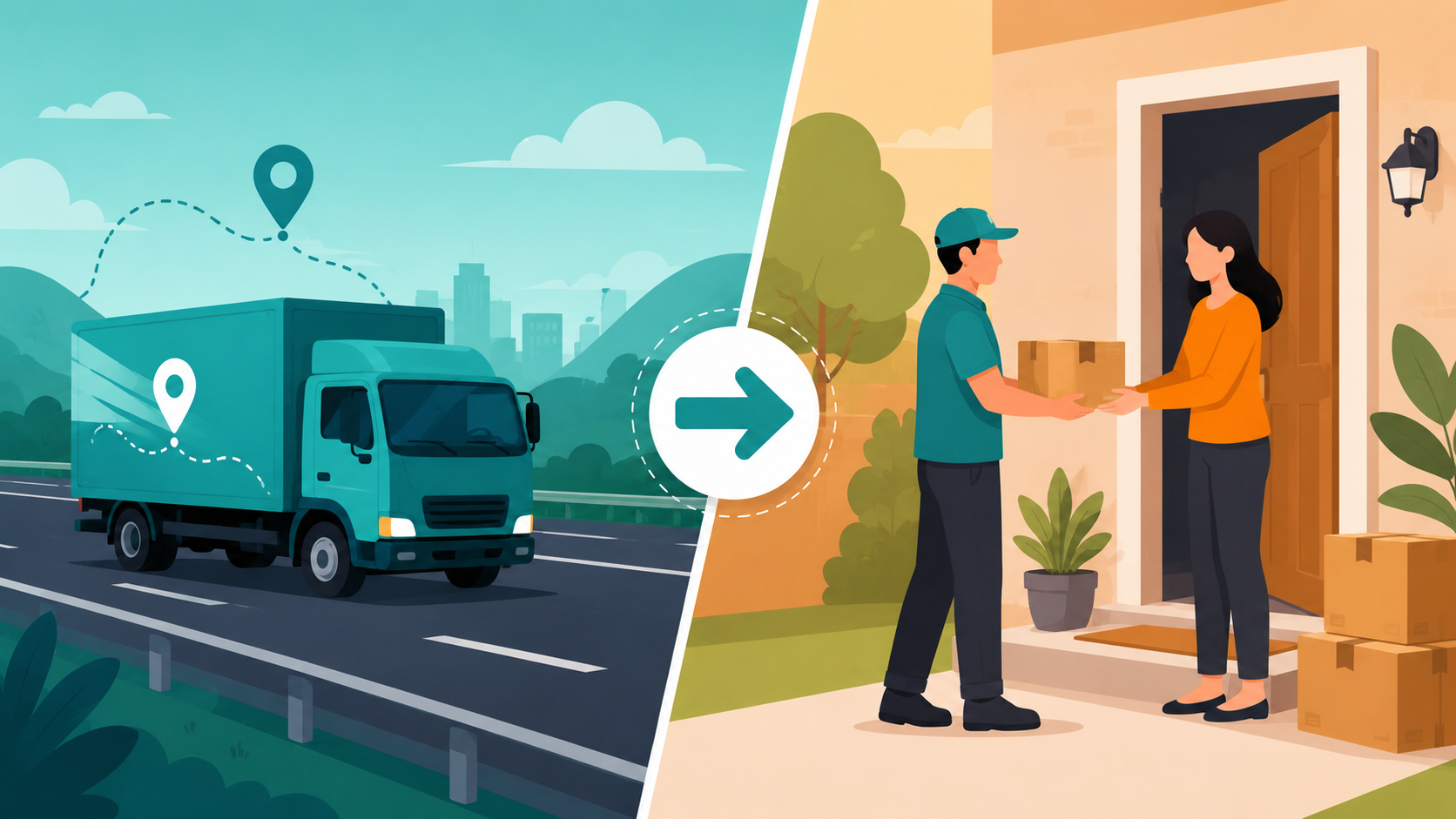
Shipping and delivery sound interchangeable, but in logistics they refer to two different events in two different timelines. Shipping is the carrier-side process — pickup, sortation, transit, and the last-mile attempt. Delivery is the customer-side event — the moment the parcel actually changes hands at the doorstep. Treating them as the same thing breaks SLAs, inflates support tickets, and quietly damages the brand promise.
For Indian D2C brands shipping under tight 2–6 day windows, getting this distinction right is what separates an honest expected-delivery date from a generic "5–7 working days" that customers stop trusting after their second order.
What is shipping in ecommerce logistics?
Shipping is everything that happens once the order leaves your warehouse and enters the courier network. It is a carrier-side process, measured by manifests and AWB scans rather than by a customer signature. Shipping starts at handover and ends at the first delivery attempt.
The stages inside shipping:
- Manifest creation — order details and weight handed to the courier
- Pickup — physical handover from your warehouse to the courier vehicle
- First-mile transit — pickup hub to origin sortation centre
- Linehaul — long-distance transit between sortation hubs
- Last-mile transit — destination hub to the customer's local branch
- Out for delivery — parcel on the courier's vehicle for the day's attempts
All of this is "shipping." None of it is "delivery" yet.
What is delivery in ecommerce logistics?
Delivery is the single discrete event at the end of shipping: the parcel changing hands at the customer's address, or being collected from a pickup point. It is measured in seconds and confirmed by a POD signal — signature, OTP, photo, or scan.
Three things matter at delivery:
- Identity verification — right person, right address
- Payment collection — for COD orders, cash or QR scanned and remitted
- Proof of delivery (POD) — captured for dispute defence later. The full mechanics are in the POD guide.
Delivery is also the only metric the customer experiences directly. They don't see your sortation logs; they see whether the parcel arrived today.
What is the practical difference for D2C brands?
The distinction shapes four operational decisions:
| Decision | Driven by shipping | Driven by delivery |
|---|---|---|
| Quoted SLA at checkout | Transit days by zone | Cutoff time + working days |
| Cost math | Forward shipping rate, fuel, COD fee | Reverse shipping when refused/returned |
| Customer comms | "Shipped" notification + AWB | "Out for delivery" + delivered email |
| Dispute handling | Lost-in-transit claim | Non-delivery / wrong-address dispute |
Shipping cost is what you pay the courier. Delivery success is what determines your RTO rate, support volume, and repeat-purchase probability.
Shipping date vs delivery date — what should you tell the customer?
The shipping date is when you hand the parcel to the courier. The delivery date is the expected arrival at the customer's door. Most D2C brands quote only one number ("delivered in 5 days") and create ambiguity at both ends.
The better pattern:
Ships by Mon 24 June — Arrives by Wed 26 June
Two dates, both honest, set against the courier's pincode SLA rather than a blended national estimate. Real per-pincode SLA data comes from the courier dashboard or your shipping aggregator's API — ShipPrime exposes per-pincode SLA across 15+ partners so the dates at checkout reflect actual transit, not a guess.
What are the common mistakes brands make?
- Quoting "delivered in 5–7 working days" on every order regardless of pincode. Sets the wrong expectation on both ends — too tight for North-East orders, too loose for local orders.
- Marking the order "delivered" in the system when the AWB hits "out for delivery" — creates a gap where customer support hears "I haven't received it" while the panel says "delivered."
- Treating shipping date as delivery date in customer comms — "your order has shipped" without a separate delivery ETA leaves the customer guessing for 3–5 days.
- Counting RTO from shipping date instead of delivery attempt date — distorts the RTO funnel and hides where the leak actually happens.
- Treating COD remittance cycle as a shipping cost when it's actually a post-delivery event. Remittance delay is a working-capital cost, not a shipping cost.
How does ShipPrime separate shipping and delivery?
ShipPrime's dashboard surfaces both timelines independently. The shipping view tracks manifest, pickup, and transit milestones across 15+ courier partners. The delivery view tracks attempt status, NDR cycle, and POD capture per shipment.
At checkout, the rate calculator pulls per-pincode shipping SLA across all enabled couriers, so the expected delivery date shown to the customer reflects the actual transit window — not a blended "5–7 days" guess. The branded tracking page keeps both stages visible to the customer on your own domain, which cuts "where is my order?" support tickets by 40–60%. COD remittance lands in D+2 from successful delivery, irrespective of how long shipping took.
Frequently Asked Questions
What is the difference between shipping and delivery? Shipping is the carrier-side process from warehouse pickup through transit to the first delivery attempt. Delivery is the discrete event of the parcel changing hands at the customer's address. Shipping is measured by AWB scans; delivery is measured by POD capture.
Is the shipping date the same as the delivery date? No. Shipping date is when the parcel is handed to the courier. Delivery date is when the parcel reaches the customer's address. The gap between them is the transit window, which varies by zone (1–2 days local, 3–6 days rest of India).
Why does the difference between shipping and delivery matter for D2C? Because customers experience delivery, not shipping. Quoting a single number ("5 days") instead of separate shipping and delivery dates creates expectation gaps that show up as bad reviews, RTO refusals, and support tickets. Two honest dates beats one blended guess.
What is POD and how is it linked to delivery? POD (proof of delivery) is the confirmation captured at the moment of delivery — signature, OTP, photo, or scan. It marks the formal end of the shipping lifecycle and the start of the remittance cycle for COD orders. Read more in the POD guide.
When does an order count as "delivered" in your system? When the courier's AWB scan registers a successful POD event, not when it hits "out for delivery." Marking earlier creates a gap where the panel says delivered but the customer hasn't received the parcel — usually the source of disputes.
Should I quote a delivery date or a shipping date on my product page? Both. "Ships by [date] — Arrives by [date]" is the clearest pattern. Customers want to know when it leaves and when it arrives. Single-date quotes ambiguate which event is being promised.
Closing Thought
Shipping is what you pay for. Delivery is what the customer remembers. Once the team is clear on which event each metric and message refers to, SLAs sharpen, support volume drops, and the brand promise stops drifting between "ordered" and "received."
Want per-pincode shipping and delivery SLAs at checkout? Start a free ShipPrime account or see ShipPrime pricing.
Ready to reduce your shipping costs?
Join thousands of D2C brands shipping smarter with ShipPrime — rates from ₹19/500g, D+2 COD remittance, and 15+ courier partners across India.
Get Started FreeHarsh Agarwal leads Growth at CityMall and ShipPrime. Previously, he was Senior Product Growth Manager at Airtel XLabs and worked on growth at Swiggy. He writes about shipping operations, unit economics, and what it takes to scale D2C brands in India.