
How to Reduce Fake Orders and COD Fraud in Indian E-commerce
Growth, CityMall | ShipPrime
Each failed COD order costs an Indian D2C brand ₹180–₹240 in shipping, repackaging, and blocked inventory. A small share of phone numbers and pincodes account for the majority of the loss — and that is exactly what makes it fixable.
How to Reduce Fake Orders and COD Fraud in Indian E-commerce
Each failed COD order costs an Indian D2C brand ₹180–₹240 — forward shipping wasted, reverse logistics paid, repackaging done, and inventory blocked for 7–14 days. For a brand at 1,000 orders/month with 25% COD RTO, that's ₹45,000–₹60,000/month leaking to fake and fraudulent orders alone, before the genuine "customer changed mind" returns are even counted.
The good news: a small share of phone numbers, addresses, and pincodes account for the majority of the loss. That concentration is exactly what makes fraud fixable with the right detection and verification stack — and the work pays back inside 30 days for almost every brand that runs it.
What are the most common COD fraud patterns in India?
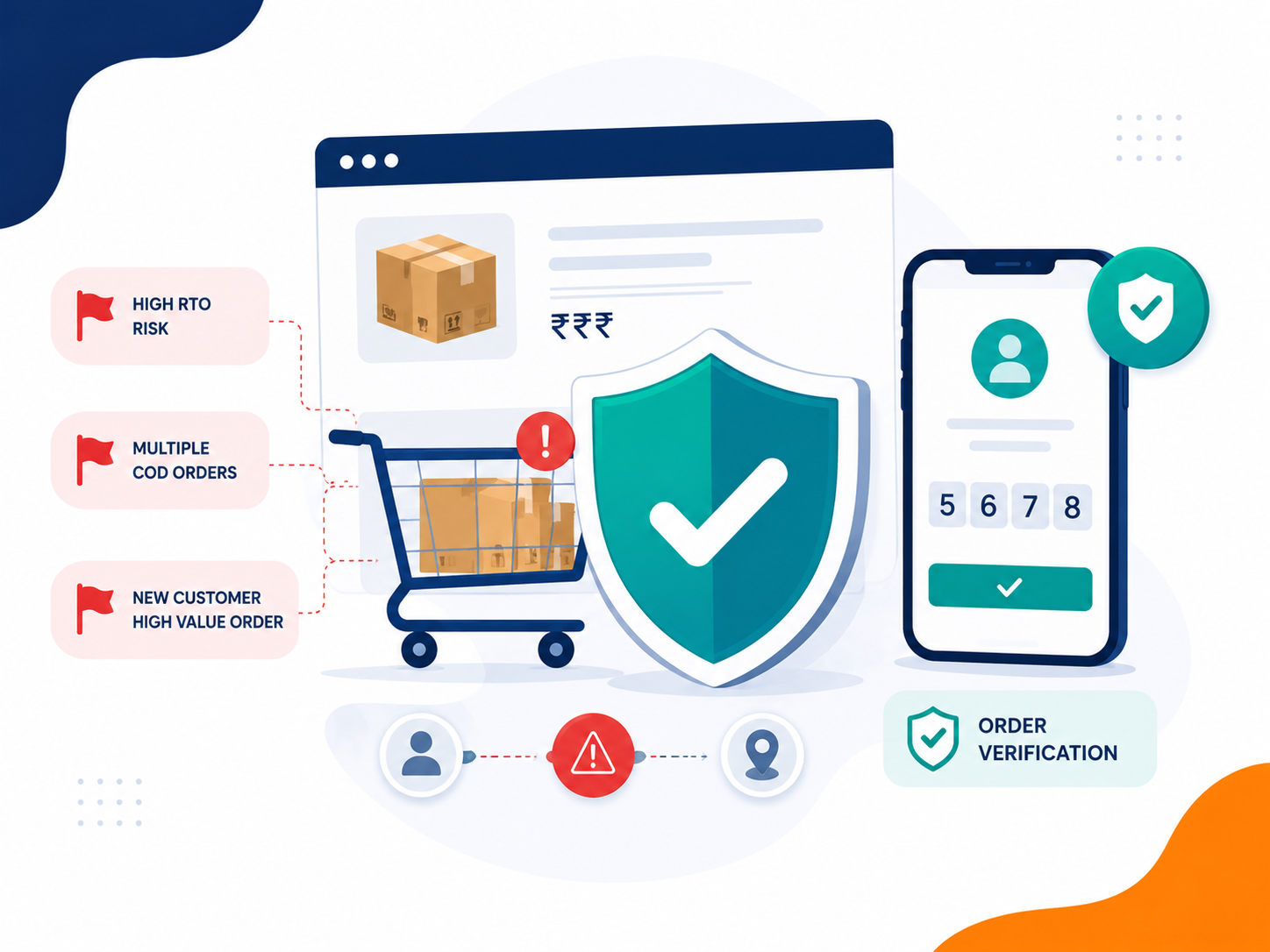
Seven patterns drive 80%+ of confirmed fake-order cases. Recognising them at checkout is the first line of defence:
- Rapid-fire orders from new accounts — three or more orders within 60 minutes from a freshly created account. Observed in 67–74% of confirmed fraud cases.
- High-value first orders — a new account placing a ₹3,000+ COD order with no prior browsing history.
- Mismatched name, address, and phone — Hindi-script name with a South Indian pincode and a non-portable landline number.
- Repeated cancellations from the same phone — multiple recent cancelled orders against the same number across email IDs.
- Bulk orders to high-RTO pincodes — five identical SKUs to a pincode with historical 50%+ RTO.
- Late-night impulse orders — 11 PM–3 AM COD orders for impulse-priced items (₹200–₹600) RTO at 2× the daytime rate.
- Pincode/courier mismatch — order address pincode not serviceable by the customer's chosen courier preference, often a flag for fake address.
Stacking even three of these patterns at checkout pushes a flag worth manual review or a forced verification step.
How much does fake-order fraud cost a typical D2C brand?
The per-event cost breakdown for one failed COD order:
| Cost line | Amount |
|---|---|
| Forward shipping (paid even on refusal) | ₹120–₹180 |
| Reverse shipping (back to warehouse) | ₹90–₹140 |
| Repackaging + QC | ₹15–₹30 |
| Inventory blocked 7–14 days (working capital, ~1% of value) | ₹15–₹40 |
| Support handling | ₹10–₹25 |
| Total per RTO event | ₹250–₹415 |
The widely cited ₹180–₹240 number is the direct logistics cost; the all-in number including working capital and support is higher. For a brand at 1,000 orders/month and 25% COD RTO, the all-in monthly leak is ₹50,000–₹80,000.
What is the difference between fake orders and high RTO?
Worth disambiguating. Fake orders are intentional — placed with no intent to receive. They behave differently from genuine high RTO, which is driven by buyer's remorse, unavailable customer, or wrong address. Detection logic differs:
- Fake orders: stack of suspicious signals at checkout (rapid-fire, address mismatch, suspicious pincode). Catch at order placement.
- Genuine RTO: customer signals (unanswered NDR calls, refusal at door). Catch at attempt.
Both eat margin. Both have separate fixes. Treat them as two leaks, not one.
Six prevention workflows that cut fraud by 35–40%
1. WhatsApp confirmation before dispatch
The single highest-ROI workflow. Auto-send a WhatsApp message asking "Confirm your order — reply YES" within 30 minutes of placement. If no confirmation within 2–4 hours, cancel the order or hold for review. Fake numbers never reply; genuine customers reply within minutes.
Brands using mandatory WhatsApp confirmation see a 30–40% drop in COD RTO within 30 days.
2. Voice AI verification call for high-risk orders
For orders flagged by rule-based scoring (high AOV, new account, high-RTO pincode), trigger an automated voice call. Invalid numbers fail the call instantly. Real customers confirm in under 30 seconds.
3. OTP verification at checkout
Send an OTP to the customer's phone before the order is confirmed. Adds 15 seconds of friction; eliminates phone-number-spoofed orders. Lower checkout-friction option than WhatsApp confirmation but doesn't catch "real number, no intent to receive" cases.
4. Pincode-level risk scoring
Score every pincode by historical RTO rate. Tier the pincodes:
- Low risk (RTO < 15%) — ship as-is, COD allowed.
- Medium risk (RTO 15–25%) — require WhatsApp confirmation, allow COD.
- High risk (RTO > 25%) — restrict to prepaid or require enhanced verification.
This single rule prevents the bulk of "high-RTO pincode" leakage.
5. Blacklist of repeat-RTO phone numbers and addresses
Maintain a rolling 90-day database of phone numbers and addresses linked to past RTOs. On a new order, check the database. If matched, route through enhanced verification or restrict to prepaid only.
A small share of phone numbers (typically <2%) accounts for 15–20% of the RTO volume. Blacklisting alone prevents the next attempt from each.
6. Convert COD to prepaid with a visible incentive
"Save ₹50 — Pay Online" at checkout converts 20–30% of COD intenders to prepaid. The math works because the saved RTO cost per converted order exceeds the ₹50 discount. The full COD-vs-prepaid economics are in the COD vs Prepaid post.
What about Shopify-specific options after Advanced COD was killed?
Shopify deprecated the Advanced COD app in 2025, leaving most Indian D2C stores without native COD filtering. Replacement options in 2026:
- Third-party COD-control apps — several Indian-built apps (and ShipPrime's checkout flow) offer COD rules, blacklists, and confirmation.
- WhatsApp-first checkout — push customers to confirm and pay via WhatsApp before order creation, sidestepping Shopify's checkout limitations.
- Manual review queue — for stores under 200 orders/day, a human review pass on flagged orders is feasible.
For WooCommerce stores, native plugins and aggregator integrations cover most of the same workflows out of the box. See How to Set Up Shipping on WooCommerce in India for the integration walkthrough.
How does ShipPrime handle fraud and fake-order prevention?
ShipPrime layers three workflows automatically. Every order is scored against pincode-level RTO history and rule-based fraud signals before dispatch — flagged orders trigger WhatsApp confirmation, and unconfirmed orders auto-cancel on the configured timer. A rolling blacklist of repeat-RTO numbers and addresses runs in the background, so each new order from a flagged source routes through enhanced verification rather than straight to dispatch.
The pincode risk dashboard surfaces RTO rate by 6-digit pincode so you can apply prepaid-only or enhanced-verification rules where the data justifies. Combined with COD remittance in D+2 and zero setup fees, brands typically see fraud-driven RTO drop 35–40% within the first 60 days.
Frequently Asked Questions
How much does COD fraud cost Indian D2C brands? Each fraudulent or failed COD order costs ₹180–₹240 in direct logistics, or ₹250–₹415 all-in including working capital and support. For a brand at 1,000 orders/month with 25% COD RTO, the monthly leak is ₹50,000–₹80,000.
How do I detect fake COD orders before shipping? Combine rule-based checks (rapid-fire order count, AOV, new-account flag, pincode risk score, name/address mismatch) with WhatsApp or voice AI confirmation. Stacking 3+ red-flag patterns at checkout catches 80%+ of fraud.
What is the most effective fraud-reduction workflow? Mandatory WhatsApp confirmation before dispatch. Single workflow, takes the customer 30 seconds, drops COD RTO by 30–40% within 30 days. Fake numbers and bots never reply.
Should I blacklist phone numbers permanently? A rolling 90-day blacklist works better than permanent. Genuine customers occasionally have a one-off RTO; permanent blacklisting blocks future legitimate orders. Tag numbers, escalate verification, and de-list after 90 clean days.
How do I reduce COD fraud on Shopify after Advanced COD was killed? Use a third-party COD-control app or a shipping aggregator with built-in fraud filtering, push WhatsApp-first checkout for high-risk orders, and run a manual review queue for flagged orders under 200/day.
Does converting COD to prepaid reduce fraud? Yes — prepaid RTO is 2–3% vs 25–30% for COD. A "Save ₹50 — Pay Online" incentive converts 20–30% of COD intenders to prepaid, and the converted orders rarely come back as RTO.
Closing Thought
Fraud and fake orders aren't a structural problem; they're a concentration problem. The same small set of phone numbers, addresses, and pincodes drive most of the loss, and the same small set of workflows — WhatsApp confirm, pincode scoring, blacklist, prepaid incentive — fix most of it. Run them together and the leak closes inside one quarter.
Want fraud detection running on every COD order? Start a free ShipPrime account or see ShipPrime pricing.
Ready to reduce your shipping costs?
Join thousands of D2C brands shipping smarter with ShipPrime — rates from ₹19/500g, D+2 COD remittance, and 15+ courier partners across India.
Get Started FreeHarsh Agarwal leads Growth at CityMall and ShipPrime. Previously, he was Senior Product Growth Manager at Airtel XLabs and worked on growth at Swiggy. He writes about shipping operations, unit economics, and what it takes to scale D2C brands in India.