
Cash on Delivery (COD) vs Prepaid: Impact on RTO and Profitability
Growth, CityMall | ShipPrime
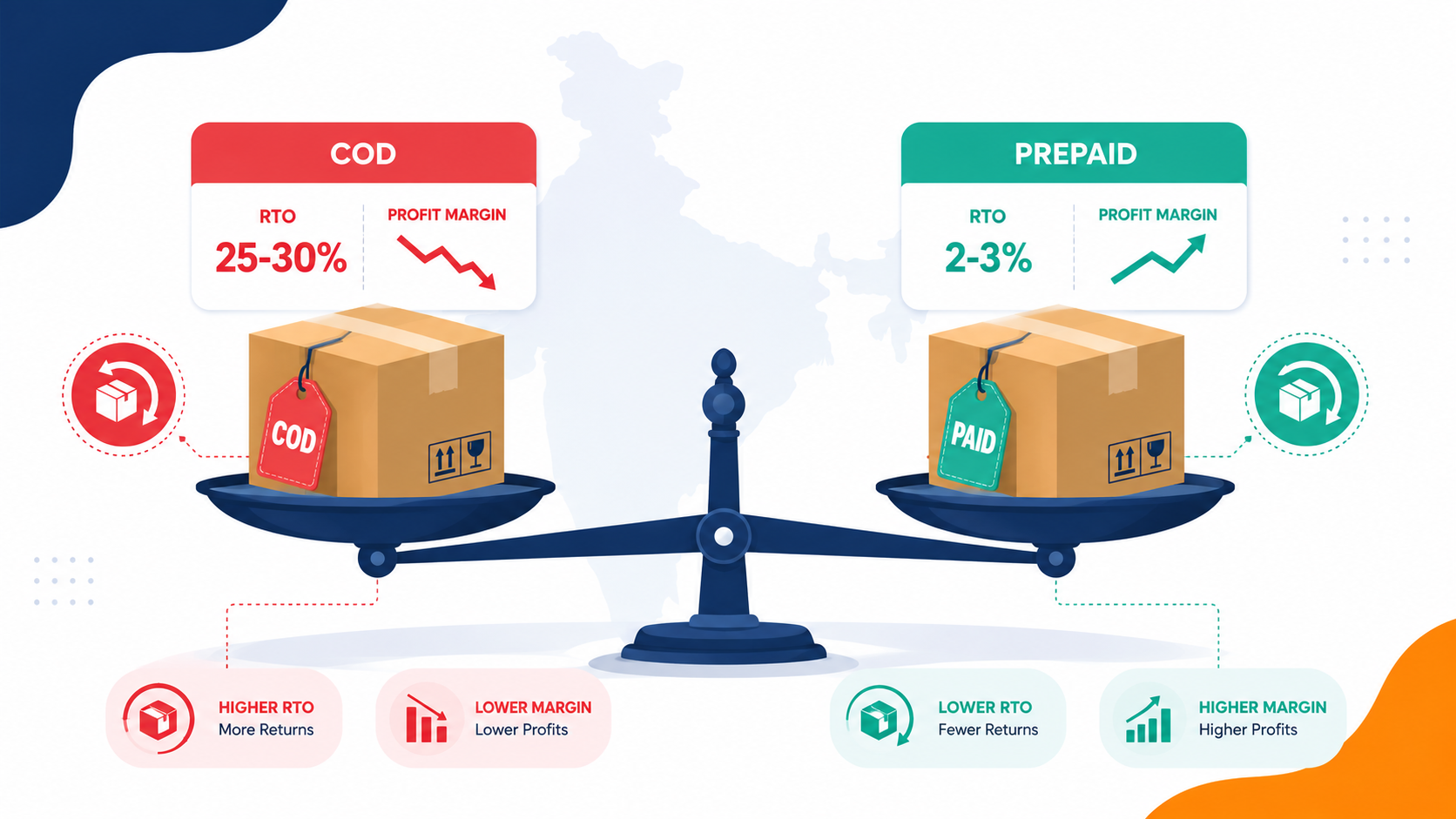
COD orders RTO at 25–30% vs 2–3% for prepaid — a 10× gap that quietly erodes D2C margin. The mix decision is not "kill COD" but "shape the COD funnel so the profitable orders ship and the rest convert to prepaid."
Cash on Delivery (COD) vs Prepaid: Impact on RTO and Profitability
COD orders RTO at 25–30% in Indian D2C. Prepaid orders RTO at 2–3%. That 10× gap is the single largest gap-between-quoted-and-realized margin in Indian eCommerce, and it is why "should we accept COD" comes up in every D2C founder conversation by month 4 of operations.
The honest answer in 2026 is that COD still drives 50–70% of D2C orders in India and isn't going away. The right framing isn't "kill COD" — it's "shape the COD funnel so the orders that are profitable ship and the ones that aren't convert to prepaid before they enter the courier network."
Why does COD have such a high RTO rate?
Four behavioural reasons stacked on top of each other:
- No commitment at checkout — the customer hasn't parted with money, so cancelling on the doorstep costs them nothing.
- Impulse buying — late-night COD orders for ₹500 items rarely survive the next morning.
- Address quality is lower — COD customers fill in fewer fields and skip pincode validation more often than prepaid buyers.
- Cash-on-hand friction — even motivated buyers can refuse a parcel because they don't have exact change or the right card on the courier's mobile POS.
The result: the industry-average COD RTO rate in 2026 sits at 25–30%, with fashion, footwear, and general merchandise touching 40% in some categories. Prepaid orders, by contrast, RTO at 2–3% because the customer has already committed money and has stronger intent.
What is the per-order cost difference?
The forward shipping cost on a COD and a prepaid order is roughly the same (₹120–₹200 depending on weight and zone). The all-in cost diverges because of three things:
| Cost component | Prepaid | COD |
|---|---|---|
| Forward shipping | ₹150 | ₹150 |
| COD fee (flat or 1.5–2.5%) | ₹0 | ₹35–₹45 |
| Reverse shipping (when RTO) | rare, ~3% × ₹120 = ₹3.60 effective | common, ~25% × ₹120 = ₹30 effective |
| Inventory blocked 7–14 days | low | high |
| Remittance delay | T+1 from gateway | D+2 to D+15 from courier |
| Effective per-order cost | ~₹160 | ~₹215+ |
Per ₹1,000 of GMV, that's a 5–6% margin compression on COD vs prepaid before you count working-capital cost of remittance delay.
What does the profitability math actually look like?
A worked example for a brand doing 1,000 orders/month at ₹1,200 average order value (AOV), 60% COD share:
- 600 COD orders × ₹1,200 = ₹7.20 L GMV from COD
- 400 prepaid orders × ₹1,200 = ₹4.80 L GMV from prepaid
COD-side costs:
- 600 forward shipments × ₹185 (incl. COD fee + GST) = ₹1.11 L
- 25% RTO = 150 reverse shipments × ₹150 = ₹22,500
- Inventory blocked on 150 RTO orders for 10 days each = working capital drag (use ~1% of order value as proxy) = ₹18,000
Total COD cost: ₹1.51 L on ₹7.20 L GMV = 21% of revenue gone to logistics.
Prepaid-side costs:
- 400 forward shipments × ₹150 = ₹60,000
- 3% RTO = 12 reverse shipments × ₹120 = ₹1,440
Total prepaid cost: ₹61,440 on ₹4.80 L GMV = 12.8% of revenue gone to logistics.
The gap is 8 percentage points of margin — and that's at a "good" 25% COD RTO. At 35% it widens to 12–14 points. The deeper unit-economics breakdown is in True Cost Per Shipment for D2C.
When is COD still the right call?
Killing COD outright destroys 40–60% of GMV for most Indian D2C brands. The right call is to accept COD but shape the funnel:
- In Tier-2/3 cities where card and UPI penetration is lower, COD is often the only way the order happens. Take it.
- For first-time customers under ₹500 AOV in low-RTO pincodes, COD is fine — the absolute loss per RTO is small.
- For known repeat customers, COD is much safer — your blacklist + history filters most fraud.
- For high-AOV orders (₹2,000+) going to new addresses, push hard for prepaid via incentive (see below).
Five levers to protect profitability without killing COD
1. Offer a small prepaid discount
A 3–5% discount or free shipping on prepaid converts 20–30% of COD intenders. The math works because the saved RTO cost on each converted order exceeds the discount given. Frame it as "Save ₹50 — Pay Online" at checkout.
2. Confirm every COD order before dispatch
WhatsApp confirmation, automated call, or OTP. Don't ship a COD order until the customer has actively confirmed. Brands using verified COD confirmation see RTO drop 30–40% in the first 30 days.
3. Use pincode-level risk scoring
Some pincodes RTO at 50%+. Track historical RTO rate per pincode and either restrict those to prepaid only or route through couriers with stronger NDR handling in that geography.
4. Maintain a blacklist of repeat-RTO numbers and addresses
A small fraction of phone numbers are responsible for a large fraction of RTO. Flag and route their next order through enhanced verification or restrict to prepaid.
5. Move COD remittance to D+2
Long remittance cycles (D+7 to D+15) lock 10–25% of monthly GMV in working capital. ShipPrime remits COD in D+2, which alone frees 5–10 days of working capital for most brands. The mechanics are in COD Remittance Cycles for D2C Cash Flow.
How does ShipPrime handle COD and RTO?
ShipPrime ships every COD order through carriers selected by pincode-level SLA, not blended rate, so high-RTO pincodes get carriers with stronger NDR handling rather than the cheapest available. The NDR automation contacts customers within 4 hours of a failed attempt to lift re-attempt success, and the dashboard exposes pincode-level RTO rates so you can apply prepaid-only rules where the data justifies it.
COD remittance lands in D+2 with zero hidden fees, which unlocks roughly 5–10 days of working capital vs. legacy D+7 to D+15 cycles. Combined, brands typically see RTO drop by up to 30% within the first 60 days while keeping COD GMV intact.
Frequently Asked Questions
What is the RTO rate for COD vs prepaid orders in India? COD RTO is 25–30% on average, touching 40% in fashion and footwear. Prepaid RTO is 2–3%. The 10× gap is structural and traces to weaker commitment, lower address quality, and impulse buying on COD.
Is COD profitable for D2C brands in 2026? COD is profitable for brands that filter the funnel — confirmed orders, pincode-level risk scoring, blacklisted repeat-RTO numbers, and prepaid incentives for high-AOV orders. Unfiltered COD typically runs at 8–14 percentage points lower margin than prepaid.
How much does one RTO order actually cost? ₹180–₹240 per RTO event — forward shipping, reverse shipping, repackaging, and 7–14 days of blocked inventory. For a brand at 25% COD RTO and 1,000 orders/month, that's ₹45,000–₹60,000/month going to RTO economics alone.
How can I reduce COD RTO without losing COD orders? WhatsApp or AI-call confirmation before dispatch, prepaid discount to convert 20–30% of COD intenders, pincode-level risk scoring, blacklisting of repeat-RTO numbers, and same-day NDR action. Together these typically cut RTO by 30–40% in 60 days.
Should I kill COD entirely? No. COD drives 50–70% of D2C GMV in India. Killing it removes too much volume, especially in Tier-2/3. The right move is to keep COD but shape the funnel with confirmation + risk scoring so the unprofitable orders never enter the courier network.
What is the fastest way to convert COD to prepaid? A small visible discount at checkout ("Save ₹50 — Pay Online") plus free shipping on prepaid. Brands report 20–30% conversion of COD intenders within 30 days of adding the incentive.
Closing Thought
The COD vs prepaid debate gets reframed once you compute the per-order all-in cost. Prepaid is structurally cheaper, but COD drives the volume — so the work isn't to pick one. It's to build the small set of guardrails that keep COD profitable: confirm before dispatch, score by pincode, blacklist repeat fraudsters, incentivize prepaid, and remit fast.
Want to cut COD RTO by up to 30% in 60 days? Start a free ShipPrime account or see ShipPrime pricing.
Ready to reduce your shipping costs?
Join thousands of D2C brands shipping smarter with ShipPrime — rates from ₹19/500g, D+2 COD remittance, and 15+ courier partners across India.
Get Started FreeHarsh Agarwal leads Growth at CityMall and ShipPrime. Previously, he was Senior Product Growth Manager at Airtel XLabs and worked on growth at Swiggy. He writes about shipping operations, unit economics, and what it takes to scale D2C brands in India.