
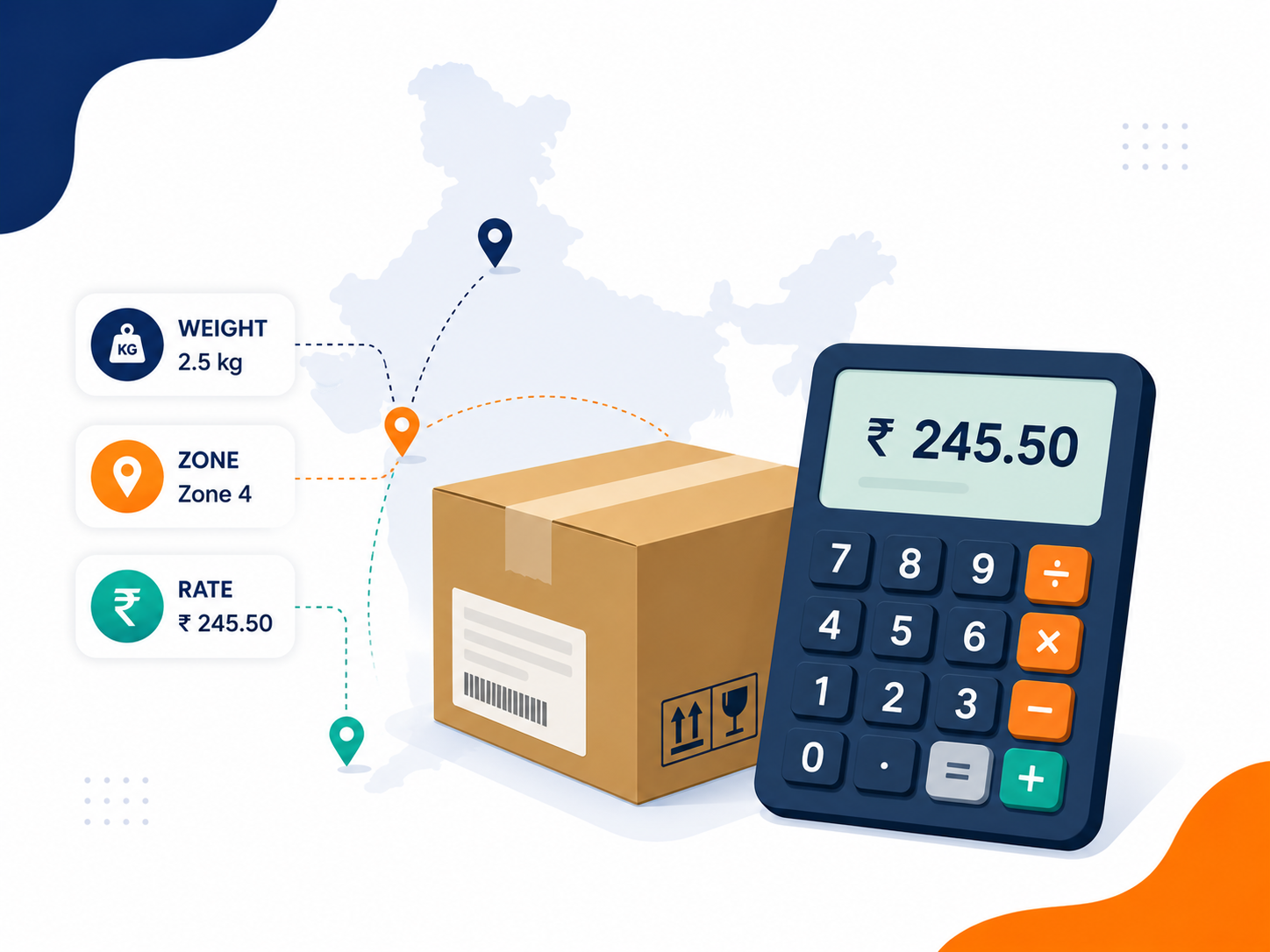
How to Calculate Shipping Costs in India: A Step-by-Step Guide for Sellers
Growth, CityMall | ShipPrime
Shipping cost in India is built from five inputs — chargeable weight, zone, courier slab, COD fee, and GST. Get the formula right and your margin holds; miss one and the courier invoice runs 20–40% over your quote.
How to Calculate Shipping Costs in India: A Step-by-Step Guide for Sellers
Shipping cost in India is built from five inputs — chargeable weight, zone, courier slab, COD fee, and GST — and a sixth hidden line item most sellers forget: the RTO buffer. Get the formula right and your margin holds. Miss one and the courier invoice runs 20–40% over what you quoted at checkout.
This guide walks through the exact math Indian couriers use, with worked examples for typical D2C SKUs, so you can price shipping confidently and stop bleeding margin to invoice surprises.
What goes into a shipping cost in India?
Indian surface shipping cost is the sum of five components, applied in this order:
- Chargeable weight — the higher of actual weight and volumetric weight, rounded up to the courier's slab (usually 500g).
- Zone rate — base price for the first slab in the destination zone (LOCAL, ZONAL, METRO, ROI, SPECIAL).
- Additional weight rate — cost per additional 500g slab beyond the first.
- COD fee — flat charge (₹25–₹50) or a percentage of order value (1.5–2.5%), whichever is higher. Applies only to COD orders.
- GST — 18% on the total forward charge (rate + COD fee).
Then add a sixth component most sellers under-budget:
- RTO buffer — for COD-heavy brands, return-to-origin orders effectively double the shipping line item per RTO event. Bake the expected RTO rate into your effective per-order cost.
How is chargeable weight calculated?
Couriers charge whichever is higher between actual weight (scale reading) and volumetric weight (a dimensional number from L × W × H).
The formula every Indian courier uses for surface shipping is:
Volumetric Weight (kg) = (L × W × H in cm) / 5000
For air shipments the divisor drops to 4000, which inflates the volumetric number.
So a parcel that is 30 × 25 × 10 cm and weighs 0.6 kg on a scale has:
- Actual weight: 0.6 kg
- Volumetric (surface): (30 × 25 × 10) / 5000 = 1.5 kg
- Chargeable weight: 1.5 kg → billed in the 1.5 kg slab
You pay for 1.5 kg even though the parcel is light. This single rule explains most "why is my invoice higher than expected" complaints in Indian D2C. Read the full mechanics in Volumetric Weight vs Actual Weight.
What are the shipping zones in India?
Indian couriers split the country into five zones for surface shipments. Pricing climbs as you move outward:
| Zone | Definition | Typical rate band (first 500g) |
|---|---|---|
| LOCAL | Same city / pincode cluster | ₹19–₹35 |
| ZONAL | Within the same state | ₹25–₹45 |
| METRO | Between metro cities (Delhi, Mumbai, Bengaluru, Chennai, Kolkata, Hyderabad) | ₹35–₹55 |
| ROI (Rest of India) | All other origin-destination pairs | ₹45–₹70 |
| SPECIAL | North-East, J&K, Andaman, remote pincodes | ₹70–₹120 |
Exact bands vary by carrier and contract. ShipPrime aggregates rates across 15+ couriers and 18,700+ pincodes, so the zone lookup is automatic when you enter origin + destination pincodes — use the shipping rate calculator for live numbers across carriers.
Step-by-step: calculate the shipping cost for one order
Use this five-step method for any order. The worked example below ships a 35 × 25 × 8 cm box weighing 0.8 kg as COD, value ₹1,200, from Bengaluru to Patna (ROI zone).
Step 1 — Compute chargeable weight
- Actual weight: 0.8 kg
- Volumetric: (35 × 25 × 8) / 5000 = 1.4 kg
- Chargeable: 1.4 kg → 1.5 kg slab (rounded up to nearest 500g)
Step 2 — Look up the zone
- Bengaluru → Patna = ROI (rest of India)
Step 3 — Apply base + additional rate
Using an indicative ROI rate card of ₹50 base for first 500g + ₹40 per additional 500g:
- First 500g: ₹50
- Two additional 500g slabs (to reach 1.5 kg): 2 × ₹40 = ₹80
- Forward shipping: ₹130
Step 4 — Add COD fee
Typical COD fee: ₹35 flat OR 2% of order value, whichever is higher.
- 2% of ₹1,200 = ₹24 → flat ₹35 is higher
- COD fee: ₹35
Step 5 — Add GST
- Subtotal: ₹130 + ₹35 = ₹165
- GST @ 18%: ₹29.70
- Final invoice cost: ₹194.70
That is what the courier will bill you for this one shipment. Now do the RTO math.
How do you factor RTO into effective per-order cost?
If you ship 100 COD orders at ₹195 forward cost and 25 of them RTO (a typical D2C COD RTO rate of 25%):
- 100 forward shipments at ₹195 = ₹19,500
- 25 reverse shipments at ~₹150 = ₹3,750 (reverse usually 70–80% of forward)
- Total cost on 100 orders: ₹23,250
- Effective per-order shipping cost: ₹232.50 (not ₹195)
A 25% RTO rate inflates your true per-order shipping by 19%. At 35% RTO it goes up by 27%. This is the single biggest gap between what sellers quote and what they actually pay.
If you're planning a price change, model the all-in number — not just the rate card. The deeper breakdown is in True Cost Per Shipment for D2C.
Worked examples across common D2C categories
| SKU | Actual wt | Box dim (cm) | Chargeable | Zone | Forward cost (incl. COD + GST) |
|---|---|---|---|---|---|
| Phone case | 80 g | 18 × 12 × 4 | 0.5 kg | LOCAL | ~₹65 |
| T-shirt (poly mailer) | 300 g | 25 × 20 × 3 | 0.5 kg | ZONAL | ~₹85 |
| T-shirt (oversized box) | 300 g | 35 × 30 × 8 | 2.0 kg | METRO | ~₹240 |
| Nutraceutical bottle | 350 g | 20 × 8 × 8 | 0.5 kg | ROI | ~₹105 |
| Cushion cover (folded) | 250 g | 30 × 25 × 6 | 1.0 kg | ROI | ~₹165 |
| Small router | 700 g | 25 × 20 × 8 | 1.0 kg | METRO | ~₹155 |
Notice rows 2 and 3 — same product, same destination, ₹155 difference because of packaging. Packaging is the lever most sellers under-use.
Common mistakes that inflate your shipping bill
- Entering product dimensions instead of outer-carton dimensions when generating the AWB. Couriers measure the outer box at the hub — mismatch guarantees a disputed weight charge.
- Ignoring the 500g rounding. A 0.6 kg parcel gets billed as 1.0 kg. A 1.1 kg parcel gets billed as 1.5 kg. Right-size to land just under a slab boundary, not just under a kilogram.
- Forgetting fuel surcharge on contracts with legacy carriers. Some rate cards add a separate 5–15% fuel surcharge that doesn't show in the headline price.
- Mixing surface and air rates in your average. Air uses divisor 4000 and is 2–3× more expensive — check the divisor on every rate card.
- Modelling COD fee as fixed when it's the higher of flat or %. On orders above ₹2,000 the percentage usually wins.
How does ShipPrime handle shipping cost calculation?
ShipPrime computes chargeable weight, zone, and slab pricing across all 15+ courier partners in one query — so you see the apples-to-apples cost before you allocate any order. The dashboard applies your contracted volumetric divisor, COD fee structure, and GST automatically, so the number you see at booking is the number that lands on the invoice.
For brands tracking effective per-order cost, ShipPrime exposes a reconciliation view that surfaces billed-vs-declared weight variance per shipment, so finance can audit packaging issues monthly instead of chasing courier-by-courier disputes. Combined with COD remittance in D+2 and zero setup fees, this removes the two biggest cash-flow surprises in Indian shipping.
Frequently Asked Questions
How are shipping costs calculated in India? Indian shipping cost = (chargeable weight × zone rate slab) + COD fee (if applicable) + 18% GST. Chargeable weight is the higher of actual weight and volumetric weight (L × W × H / 5000 for surface, /4000 for air).
What is the formula for chargeable weight in Indian couriers? Volumetric weight = (Length × Width × Height in cm) ÷ 5000 for surface, ÷ 4000 for air. The chargeable weight is whichever is higher between actual weight and volumetric weight, rounded up to the courier's 500g slab.
What is the average shipping cost in India for D2C? Forward shipping for a 0.5 kg parcel ranges from ₹19 (local, contracted aggregator rate) to ₹70 (rest of India, retail rate). Effective per-order cost is 15–30% higher once you factor in RTO and reverse logistics.
How much is the COD charge in India? COD fees are typically ₹25–₹50 flat OR 1.5–2.5% of order value, whichever is higher. GST at 18% applies on top of the COD charge.
Why is my shipping invoice higher than the rate card? Three usual reasons: the courier remeasured your parcel at the hub and raised the chargeable weight, fuel surcharge was added on top of the headline rate, or RTO shipments were billed back to you. Audit declared-vs-billed weight monthly to catch the first one.
How can I reduce my shipping cost in India? Right-size cartons to drop a 500g slab, switch to poly mailers for soft goods, consolidate orders to the same pincode where possible, negotiate per-zone rather than blended rates, and route COD-prone pincodes through couriers with stronger RTO outcomes.
Closing Thought
Shipping cost in India isn't one number — it's a stack of five inputs plus a sixth hidden RTO charge. Once you can compute the all-in per-order cost for your typical SKU, every other shipping decision (carrier mix, packaging, COD vs prepaid push) becomes a clearer trade-off rather than a guess.
Ready to see your real shipping cost across 15+ couriers? Start a free ShipPrime account or see ShipPrime pricing.
Ready to reduce your shipping costs?
Join thousands of D2C brands shipping smarter with ShipPrime — rates from ₹19/500g, D+2 COD remittance, and 15+ courier partners across India.
Get Started FreeHarsh Agarwal leads Growth at CityMall and ShipPrime. Previously, he was Senior Product Growth Manager at Airtel XLabs and worked on growth at Swiggy. He writes about shipping operations, unit economics, and what it takes to scale D2C brands in India.