
Volumetric Weight vs Actual Weight: How Couriers Charge in India
Growth, CityMall | ShipPrime
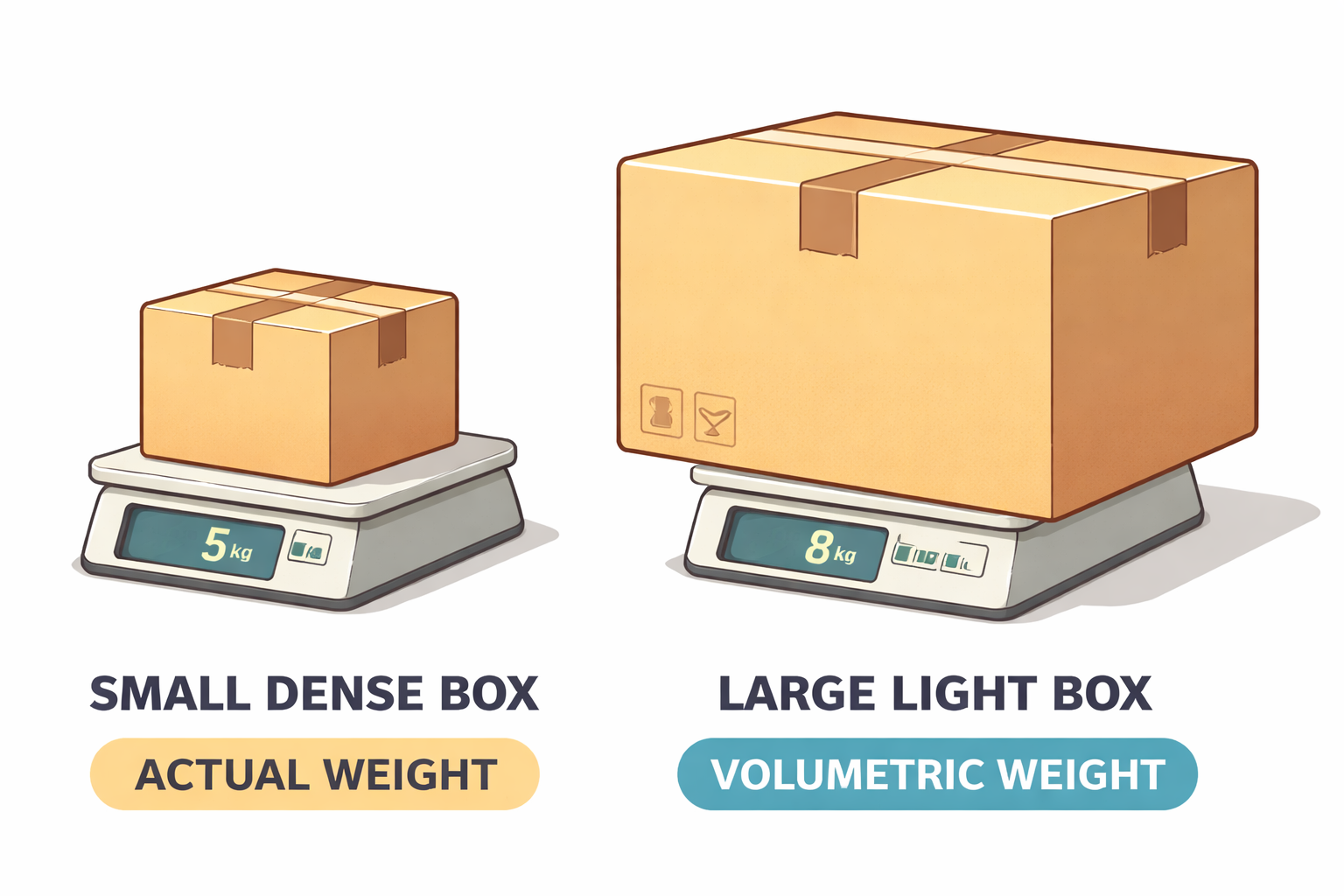
Volumetric weight is the dimensional weight a courier assigns to a parcel based on the space it occupies, not how heavy it actually is
Volumetric Weight vs Actual Weight: How Couriers Charge in India
Volumetric weight is the dimensional weight a courier assigns to a parcel based on the space it occupies, not how heavy it actually is. For Indian D2C sellers, this single rule decides whether your shipping invoice matches the rate card or runs 30–60% over budget — and most overcharges trace back to one mistake in packaging.
What is volumetric weight calculation?
Couriers charge you for the larger of two numbers: the actual weight (what your parcel weighs on a scale) and the volumetric weight (a number derived from the parcel's dimensions). The higher of the two is called the chargeable weight, and that's what shows up on your invoice.
The formula every Indian courier uses for surface shipments is:
Volumetric Weight (kg) = (Length × Width × Height in cm) / 5000
For air shipments, the divisor drops to 4000, which makes the volumetric weight higher and the chargeable weight bigger.
So a parcel that is 30 × 30 × 30 cm and weighs 1.2 kg on a scale will be billed at:
- Actual weight: 1.2 kg
- Volumetric (surface): (30 × 30 × 30) / 5000 = 5.4 kg
- Chargeable weight: 5.4 kg
You pay for 5.4 kg even though the box is light. That is the single most common source of "why is my shipping invoice higher than expected" complaints in Indian e-commerce.
Why does volumetric weight exist at all?
A courier truck has a fixed volume, not a fixed weight capacity. A 14-foot vehicle can carry roughly 2,500 kg of dense parcels — or one truckload of cushion covers that weigh 400 kg in total but fill the same space. If the courier charged purely on actual weight, the cushion-cover shipment would underpay for the space it occupies, and the courier would lose money on every light, bulky shipment.
Volumetric weight makes pricing space-aware. The rule is consistent across Delhivery, Blue Dart, XpressBees, DTDC, Ekart, Shadowfax, and India Post — they all apply it, though the exact divisor changes by mode (surface vs air) and occasionally by contract.
How do you calculate chargeable weight in practice?
Three measurements, two numbers, one decision:
- Measure length, width, and height of the outer carton in cm — after packing, not the product.
- Compute volumetric weight using the divisor for your shipping mode (5000 for surface, 4000 for air).
- Compare with actual weight on the scale. The higher number is what you pay.
If you want to skip the manual math, the volumetric weight calculator on ShipPrime gives you the chargeable weight across surface and air in one input.
Worked examples across common D2C categories
| Category | Actual weight | Outer dim (cm) | Volumetric (surface) | Chargeable | Notes |
|---|---|---|---|---|---|
| Phone case | 80 g | 18 × 12 × 4 | 0.17 kg | 0.5 kg slab | Rounded up to nearest 500g slab |
| Apparel (T-shirt in poly bag) | 300 g | 25 × 20 × 3 | 0.30 kg | 0.5 kg slab | Tight packaging keeps you in the lowest slab |
| Apparel (T-shirt in oversized box) | 300 g | 35 × 30 × 8 | 1.68 kg | 2.0 kg slab | Wrong box pushes you 4 slabs higher |
| Nutraceutical bottle | 350 g | 20 × 8 × 8 | 0.26 kg | 0.5 kg slab | |
| Cushion cover (folded) | 250 g | 30 × 25 × 6 | 0.90 kg | 1.0 kg slab | |
| LED bulb (in retail box) | 120 g | 12 × 12 × 14 | 0.40 kg | 0.5 kg slab | |
| Electronics (small router) | 700 g | 25 × 20 × 8 | 0.80 kg | 1.0 kg slab |
Notice how packaging choice — not product weight — moves the chargeable weight across two of these examples. That's the lever most sellers under-use.
How big is the volumetric weight problem for D2C brands?
For brands shipping apparel, footwear, home decor, kitchenware, or anything bulky-but-light, volumetric weight typically accounts for 30–50% of total chargeable weight across the catalog. A brand shipping 1,000 orders a day at an avg chargeable weight of 1.2 kg instead of 0.8 kg pays roughly ₹40,000–₹60,000 extra per month in surface charges alone — before adding RTO and forward-return cycles.
This is also where most invoice disputes start. The courier weighs and measures at their hub. If their reading is higher than what you declared, they raise the chargeable weight on that shipment unilaterally. You then have to file a dispute, which can take 7–15 days to resolve.
Volumetric divisors: what changes between Delhivery, Blue Dart, XpressBees, DTDC, and Ekart?
The base rule is the same — divisor 5000 for surface, 4000 for air — but a few practical differences matter:
- Surface vs express (air): every major Indian courier uses 5000 on surface and 4000 on premium air services like Blue Dart's Domestic Priority or Delhivery's Express. Verify the divisor on your contract before you assume.
- International: international air shipments typically use 5000 too (IATA standard), though some couriers move it down to 4000 or even 3500. Always check the rate card.
- Reverse / RTO shipments: same divisor as forward, but the return weight on the manifest is whatever the customer ships back — which can be different if they re-pack into a different box.
You can pull rate cards across 15+ couriers from a single dashboard via ShipPrime; the rate-card import process normalizes divisors and rounds-up rules so cross-carrier quotes stay apples-to-apples.
If you want zone-wise rate comparison across these carriers without manually pulling each card, the shipping rate calculator gives you all 15+ partners' pricing in one query, with volumetric weight already factored in.
How can D2C brands reduce volumetric weight charges?
Six practical steps that move chargeable weight downward — none of them require a logistics team.
- Right-size your master cartons. Most brands ship in one or two stock box sizes because of bulk procurement. The savings from cutting a 35 × 30 × 8 cm box down to 25 × 20 × 5 cm pays back the higher per-unit cost of multiple SKU-specific cartons within 30–45 days.
- Use poly mailers for apparel and soft goods. A 250 g T-shirt in a poly mailer has a volumetric weight of ~0.15 kg. The same T-shirt in a corrugated box hits 1.6+ kg. Poly mailers also reduce damage rates for soft goods.
- Eliminate void fill. Air pillows, crumpled paper, and bubble wrap inflate volume without adding actual weight. Fit the product, then size the box.
- Audit your top-selling SKUs first. 80% of your shipments come from 20% of SKUs. Right-size packaging for those 20% before touching the long tail.
- Measure outer carton — not product — when you generate the AWB. Many sellers enter product dimensions; the courier weighs the outer carton. The mismatch is a guaranteed dispute.
- Track invoice variance monthly. If your billed weight is consistently 10%+ higher than your declared weight, it's a packaging audit signal, not a courier issue. Fix it upstream.
How does ShipPrime handle volumetric weight?
ShipPrime applies the same volumetric formula every Indian courier uses, but the dashboard normalizes the math before you book a shipment. When you enter dimensions and actual weight, the system shows the chargeable weight across all 15+ courier partners with your contracted divisors already applied — so you see the apples-to-apples cost difference before you allocate the order.
For dispute management, ShipPrime tracks the declared vs billed weight for every shipment and flags variance above your threshold. That gives finance teams a monthly weight-audit report instead of a courier-by-courier reconciliation spreadsheet. Combined with COD remittance in D+2 and zero setup fees, it removes the two biggest cash-flow surprises in Indian e-commerce shipping.
Frequently Asked Questions
What is volumetric weight in shipping? Volumetric weight is a dimensional weight calculated from a parcel's length × width × height divided by a fixed divisor (5000 for surface, 4000 for air in India). Couriers charge whichever is higher: actual weight or volumetric weight.
What is the volumetric weight formula used by Indian couriers? Volumetric Weight (kg) = (L × W × H in cm) / 5000 for surface. For air shipments, divide by 4000. The higher of volumetric weight and actual weight becomes your chargeable weight.
Why is my shipping invoice higher than the product weight? Because your chargeable weight is the higher of actual or volumetric. If your parcel is light but bulky, volumetric weight wins and you pay for the space, not the mass.
How can I reduce volumetric weight charges? Right-size your cartons, switch to poly mailers for soft goods, eliminate void fill, and measure outer-box dimensions when generating the AWB. Most D2C brands cut 10–25% off shipping costs from packaging changes alone.
Is volumetric weight the same across all couriers in India? The base formula is the same (divisor 5000 surface, 4000 air), but contracts can specify different divisors. Always confirm the divisor on each carrier's rate card before assuming.
What is chargeable weight? Chargeable weight is whichever is higher between actual weight (scale reading) and volumetric weight (dimensional calculation). It's the number couriers actually bill you on.
Closing Thought
Volumetric weight is the most common reason Indian D2C brands see shipping costs they didn't budget for. The math is fixed; the lever is packaging. A weekend spent right-sizing your top-20 SKU cartons usually pays back faster than any rate renegotiation.
Ready to see how your shipping costs change across 15+ couriers? Start a free ShipPrime account or see ShipPrime pricing.
Ready to reduce your shipping costs?
Join thousands of D2C brands shipping smarter with ShipPrime — rates from ₹19/500g, D+2 COD remittance, and 15+ courier partners across India.
Get Started FreeHarsh Agarwal leads Growth at CityMall and ShipPrime. Previously, he was Senior Product Growth Manager at Airtel XLabs and worked on growth at Swiggy. He writes about shipping operations, unit economics, and what it takes to scale D2C brands in India.