
What is Zone Skipping? How It Reduces Shipping Costs for D2C Brands
Growth, CityMall | ShipPrime
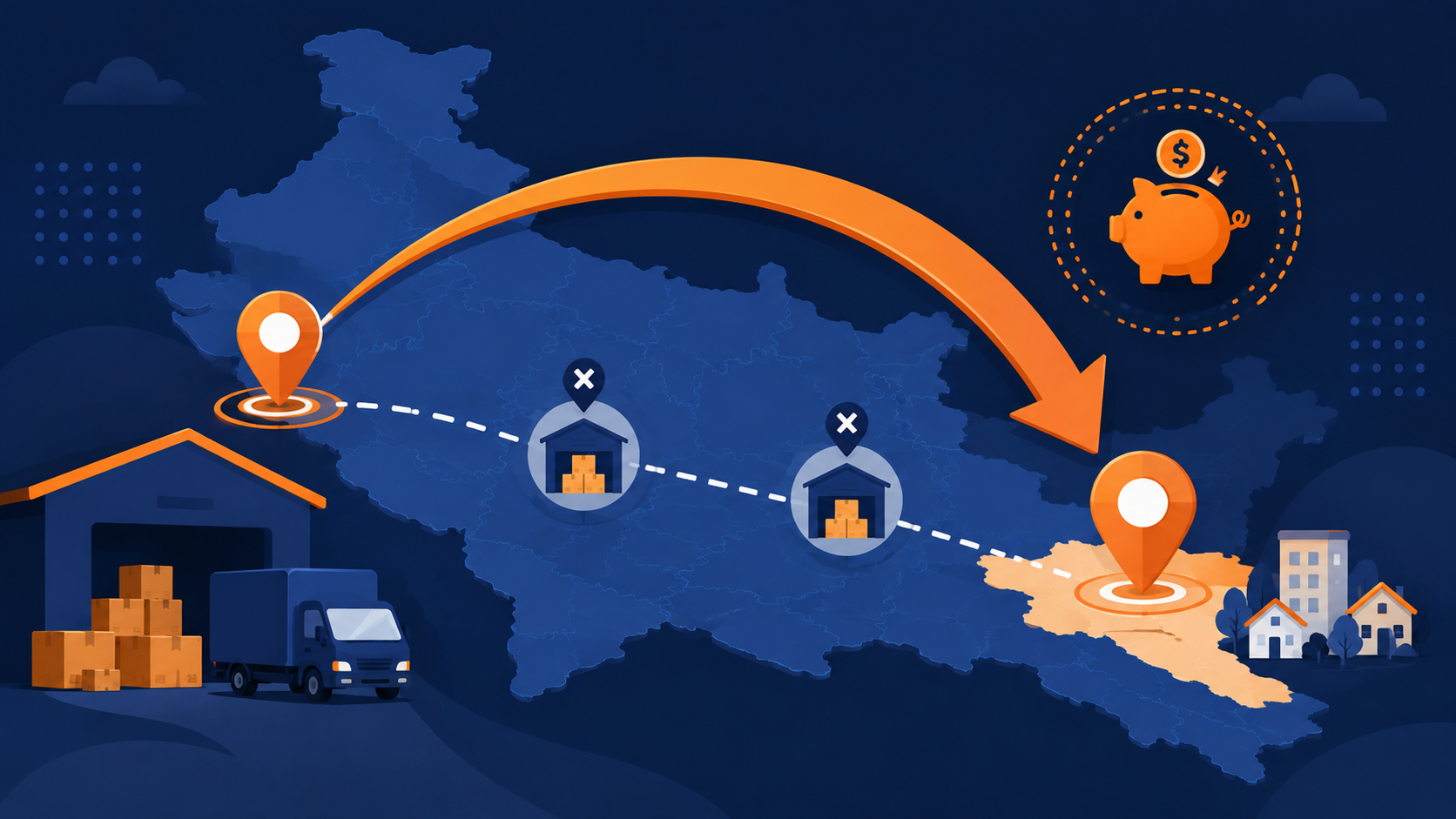
Zone skipping is the practice of bulk-moving parcels closer to their destination zone before they enter the courier's normal sortation network — cutting both transit time and per-shipment cost. For high-volume D2C brands, the savings run 15–30% on long-haul orders.
What is Zone Skipping? How It Reduces Shipping Costs for D2C Brands
Zone skipping is the logistics practice of bulk-moving parcels closer to their destination zone before they enter the courier's normal sortation network. Instead of one parcel hopping through three or four courier hubs, a truckload of parcels skips those intermediate stages and joins the local last-mile leg directly. For high-volume D2C brands, this cuts both transit time and per-shipment cost by 15–30% on long-haul orders.
The technique has been standard in US/EU logistics for years and is now mature enough in India that aggregator-level brands shipping 200+ orders a day to distant zones can build it into their cost model. This post explains how it works, when it pays back, and where it doesn't.
How does zone skipping actually work?
A normal D2C parcel from Bengaluru to Patna travels through five legs:
- Warehouse → Bengaluru hub (first-mile pickup)
- Bengaluru hub → Hyderabad sortation
- Hyderabad → Kolkata sortation
- Kolkata → Patna hub
- Patna hub → customer's door
Each hub stop adds 12–36 hours of dwell time and a per-parcel handling charge. Zone skipping consolidates outbound orders to the same distant zone (say, all Patna-bound orders for the week) into a single truck and delivers them straight to the Patna hub. The middle three legs disappear. Only the first-mile and last-mile remain on the per-parcel cost.
The same principle works for any high-volume origin-destination pair where the freight cost of one consolidated truck divided across many parcels lands below the standard per-parcel rate.
What does the cost math look like?
A worked example for 500 parcels/week shipping Bengaluru → Patna, average chargeable weight 1 kg:
Standard surface shipping:
- 500 × ₹160 per parcel = ₹80,000/week
- Average transit: 5–6 days
Zone-skipped option:
- 1 truck Bengaluru → Patna hub (line haul) at ~₹35,000 for 500 kg
- Last-mile only at Patna (~₹50/parcel × 500) = ₹25,000
- Total: ₹60,000/week
- Average transit: 3–4 days
Savings: ₹20,000/week (25%) plus 1–2 days off transit. The math turns negative below ~150 parcels/week on the same OD pair, because the line-haul cost stops amortising.
When does zone skipping make sense?
Three conditions must hold:
- Sustained volume to a specific destination zone — typically 150+ parcels/week, ideally same-day-dispatch ready.
- The destination zone is far — long-haul ROI or Special zones (North-East, Tier-3 outliers) where the per-parcel hub cost is highest.
- You can hold orders by 12–24 hours to consolidate the truck, without breaking customer SLA.
If any of these break, standard parcel shipping is cheaper and faster.
When is zone skipping not the right call?
- Volume below threshold — under 100 parcels/week to one zone, the truck cost dominates.
- Local and zonal orders — savings are minimal because intermediate hubs don't add much cost on short legs.
- Time-sensitive SKUs — perishables, gifts with date promises, or any order quoting <72h delivery doesn't tolerate consolidation hold.
- Mixed-weight loads — zone skipping economics get noisy if weight per parcel varies 5×. Best for catalogues with consistent SKU weight.
- Returns-heavy categories — reverse logistics doesn't zone-skip well, so brands with 30%+ RTO see the savings eroded on return flow.
How can D2C brands access zone skipping in India?
Direct relationships with line-haul fleet operators work above ~1,000 parcels/week per destination zone. Below that, the practical access route is via shipping aggregators that already run consolidated long-haul lanes on behalf of multiple brands.
The aggregator side of zone skipping looks like normal multi-courier shipping at the booking layer — you pick a service level (Express, Surface, Economy), the platform routes via a consolidated lane when one exists for your OD pair, and the savings show up as a lower zone rate. ShipPrime exposes consolidated-lane pricing alongside standard surface rates so brands can pick the cheaper option per order without managing the logistics behind it.
How does zone skipping compare to other shipping cost levers?
| Lever | Savings range | Effort | When it works |
|---|---|---|---|
| Right-sized packaging | 10–25% | Low (one-time) | Any volume |
| Multi-carrier rate negotiation | 5–15% | Medium (quarterly) | 500+ orders/month |
| Zone skipping | 15–30% on long-haul | Medium-High | Sustained volume to specific zones |
| RTO reduction | 5–15% effective cost | High (ongoing) | COD-heavy brands |
| Switching to surface from air | 40–60% | Low | When customer SLA allows |
For most D2C brands under 200 orders/day, the higher-ROI levers are right-sized packaging and RTO reduction. Zone skipping enters the picture once you cross 150+ daily orders with clear zone concentration. The full per-shipment cost breakdown is in True Cost Per Shipment for D2C.
How does ShipPrime handle zone skipping?
ShipPrime routes orders across 15+ courier partners and consolidated long-haul lanes from a single API call. When your OD pair has a consolidated lane available, the dashboard surfaces it alongside standard surface rates so you can pick the cheaper option per order or set a default routing rule. No manual line-haul booking required.
For brands shipping 200+ orders/day, the routing engine identifies high-volume OD pairs automatically and recommends lanes worth consolidating, with the expected savings per shipment. COD remittance lands in D+2 regardless of which lane the order ships through, and pricing remains transparent at the per-shipment level.
Frequently Asked Questions
What is zone skipping in shipping? Zone skipping is the logistics practice of consolidating multiple parcels into a single line-haul truck that bypasses the courier's intermediate sortation hubs and goes directly to the destination zone's last-mile network. It cuts both per-parcel cost and transit time.
How much can zone skipping save? Typically 15–30% on long-haul orders (ROI and Special zones) when volume to a single destination is sustained above 150 parcels/week. Savings are minimal on local and zonal orders.
What is the minimum volume needed for zone skipping? Around 150 parcels/week per destination zone is the practical break-even. Below that, the fixed cost of the line-haul truck doesn't amortise across enough parcels to beat standard per-parcel pricing.
Does zone skipping affect delivery time? Yes — usually positive. By skipping 2–3 intermediate hub stops, transit shortens by 1–2 days on long-haul lanes. The trade-off is an upfront 12–24 hour hold to consolidate the truck, which still nets faster than standard hub-to-hub transit.
Is zone skipping the same as direct injection? Closely related. Direct injection drops parcels at the destination zone's first sortation hub; zone skipping can go a stage further by bypassing that hub too and joining at the last-mile branch. Both cut intermediate sortation costs.
Can small D2C brands do zone skipping? Not directly — line-haul truck minimums are too high. Indirect access is via shipping aggregators that run consolidated lanes across multiple brands' volumes. The brand books normally; the aggregator picks the consolidated lane when one exists.
Closing Thought
Zone skipping is a high-ROI lever once your volume to specific destinations is steady, and a distraction below that threshold. The honest order of operations for most D2C brands: right-size packaging first, reduce RTO second, negotiate carrier rates third, and only then think about consolidated lanes. Run them in that order and the shipping cost line item drops without complicating the back office.
Want consolidated-lane pricing alongside standard rates? Start a free ShipPrime account or see ShipPrime pricing.
Ready to reduce your shipping costs?
Join thousands of D2C brands shipping smarter with ShipPrime — rates from ₹19/500g, D+2 COD remittance, and 15+ courier partners across India.
Get Started FreeHarsh Agarwal leads Growth at CityMall and ShipPrime. Previously, he was Senior Product Growth Manager at Airtel XLabs and worked on growth at Swiggy. He writes about shipping operations, unit economics, and what it takes to scale D2C brands in India.