
What is AWB Number? Complete Guide to Tracking in India
Growth, CityMall | ShipPrime
An **AWB number** is the unique tracking ID a courier generates for every shipment — the single string of letters and digits that lets you, your customer, and the courier locate a parcel anywhere in the network.
What is AWB Number? Complete Guide to Tracking in India
An AWB number is the unique tracking ID a courier generates for every shipment — the single string of letters and digits that lets you, your customer, and the courier locate a parcel anywhere in the network. For Indian D2C sellers, the AWB number is the most-asked field in customer support tickets, and understanding it well saves hours of back-and-forth every week.
What is AWB number in shipping?
AWB stands for Air Waybill, originally an international air-cargo document under IATA rules. In Indian e-commerce, the term has expanded — AWB now refers to the universal shipment identifier whether the parcel moves by surface or air. Every courier (Delhivery, Blue Dart, XpressBees, DTDC, Ekart, Shadowfax, India Post, and others) issues one when the shipment is booked.
The AWB number does three things at once:
- Identifies the shipment uniquely inside the courier's network
- Acts as the contract reference between sender, courier, and consignee
- Drives every scan event — pickup, in-transit, out-for-delivery, delivered, NDR, RTO — back to one trackable record
If a parcel does not have an AWB number, it does not exist in the courier system. Period.
What is the full form of AWB?
AWB stands for Air Waybill. The "Air" is a legacy term — in current Indian e-commerce it covers surface, express, hyperlocal, and reverse shipments. Some couriers call it a shipment ID, tracking ID, consignment number, or CN number instead, but the function is identical: one shipment, one ID.
What does an AWB number look like?
There's no single format. Each courier picks its own length and structure, which is why customer support gets confused when a buyer pastes one carrier's AWB into another's tracker.
| Courier | Typical AWB format | Length |
|---|---|---|
| Delhivery | Numeric, e.g. 1234567890123 | 12–14 digits |
| Blue Dart | Numeric, e.g. 12345678901 | 10–11 digits |
| XpressBees | Alphanumeric, e.g. 12345678AB | 10–14 characters |
| DTDC | Alphanumeric, e.g. X1234567 | 7–10 characters |
| Ekart | Alphanumeric, e.g. FMPP0123456789 | 12–18 characters |
| Shadowfax | Numeric, e.g. SF12345678 | 10–12 characters |
| India Post (Speed Post) | EE/CP prefix + 9 digits + IN, e.g. EE123456789IN | 13 characters |
The format you see on the label is the source of truth. If a customer reads it from a packing slip vs the courier's SMS vs your tracking page, the value should match exactly.
Where do you find the AWB number?
In Indian D2C, the AWB number shows up in five places. Train your CX team to check them in this order:
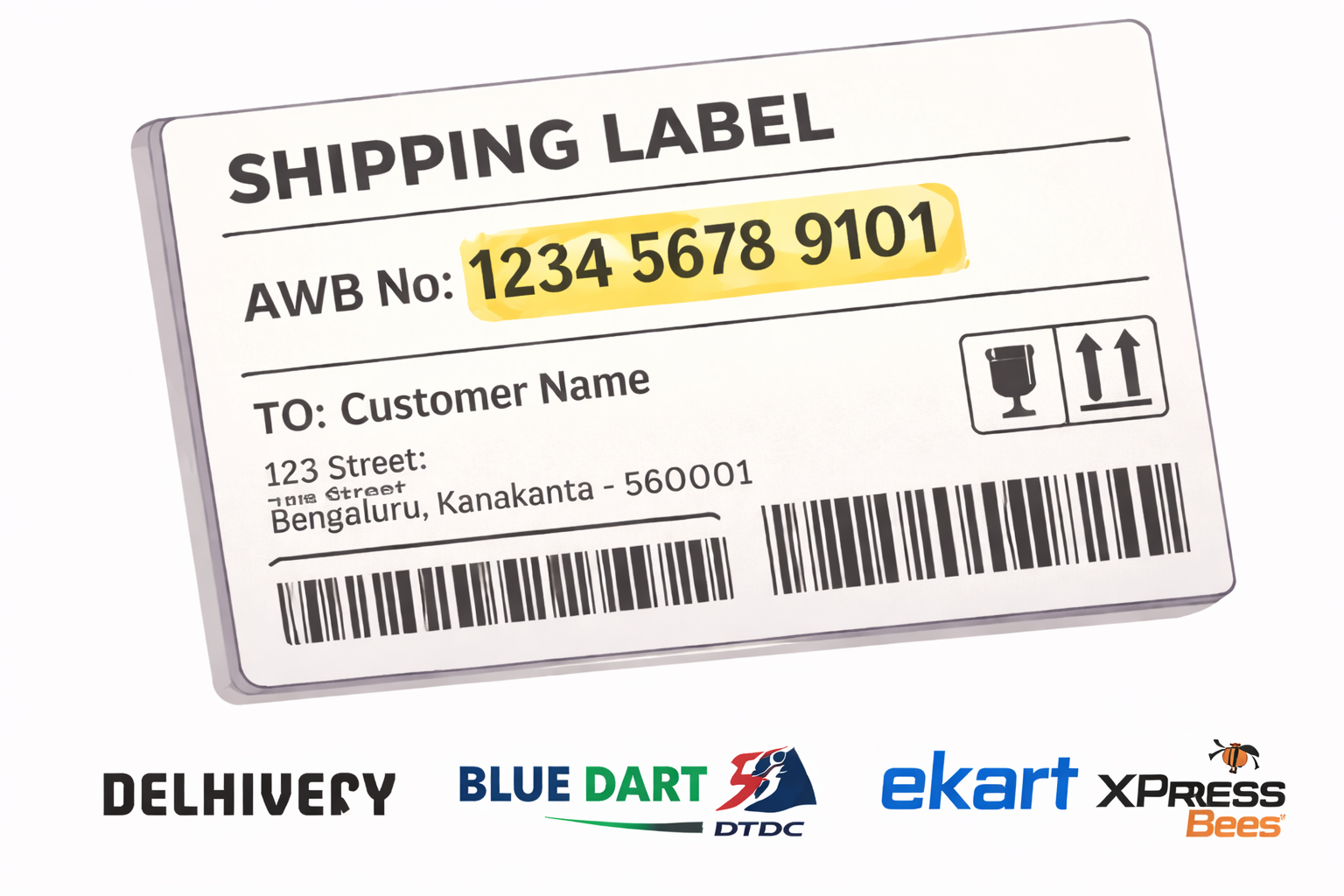
- Shipping label on the parcel itself — printed as a barcode plus the human-readable string below.
- Order confirmation email or SMS the customer received after dispatch.
- Your shipping dashboard (whether single-courier or aggregator) — searchable by order ID.
- Manifest — the daily document you hand to the pickup agent. Lists every AWB and corresponding order.
- Courier's tracking page — useful if you have the AWB but want to verify which courier owns it.
If you're running multi-courier ops and your customer comes back with only an AWB number (not a courier name), the format usually tells you who issued it. Aggregator dashboards short-circuit this — you paste the AWB and the system identifies the carrier automatically. If you want to look up an AWB across carriers from one search box, track your order on ShipPrime does exactly this.
How is the AWB number generated?
The moment a shipment is booked in the courier's system (via API call, dashboard manifest, or pickup request), the courier reserves an AWB from its inventory and assigns it to that shipment. The number is then printed on the label that gets pasted on the parcel.
For aggregator users, the booking call happens behind the scenes when you click "Generate Label" — the aggregator calls the chosen courier's API, gets an AWB back, prints the label, and returns the AWB to your dashboard. A 100-order batch typically resolves in under 30 seconds.
How do you track an AWB number across Indian couriers?
Three reliable paths:
- Courier's own tracker — every courier has a public tracking page. Works if you already know which carrier handles the shipment.
- Aggregator dashboard — one search box, all 15+ courier partners auto-identified. Useful when you don't remember which courier was used for that specific order.
- WhatsApp / branded tracking page — if your store has a customer-facing tracking page wired up, the AWB drives all the status updates the customer sees.
For events to fire in real time, the courier's scanning operations must push every checkpoint scan back to the network. Delays usually mean the parcel was offloaded at a hub but not yet rescanned — not that it's lost.
What do you do when AWB tracking is stuck?
The four most common "stuck AWB" scenarios and how to handle each:
- No update for 24–48 hours after pickup. Likely the parcel is at a sorting hub awaiting line-haul. Wait 24 more hours before raising a ticket.
- Stuck on "Out for Delivery" for 2+ days. First delivery attempt failed but courier hasn't logged the NDR scan. Raise a re-attempt request through your dashboard and confirm consignee phone number with the customer.
- Stuck on "In Transit" for 5+ days. Possible misroute or damage in transit. File an enquiry with the courier through your aggregator's ops team; ask for the last physical location scan.
- Status says "Delivered" but customer didn't receive the parcel. Request the proof-of-delivery — signed POD or photo POD — from the courier. This often resolves false-delivery scans.
For every case, the AWB number is the only thing the courier's ops team needs to investigate. The order ID is for your internal records; the AWB is what the courier searches by.
What does it mean when AWB shows delivered but the customer didn't receive it?
Either the parcel was handed to a neighbor, building security, or someone at the address who didn't pass it along — or there's a false-delivery scan. Request POD with signature or photo. If POD shows no recipient or shows the wrong address, file a claim within the courier's claim window (typically 7–30 days from the delivery scan).
How does ShipPrime handle AWB management?
Every shipment booked through ShipPrime gets an AWB from one of 15+ courier partners, normalized into a single tracking event stream on your dashboard. The AWB is searchable from the order ID, customer phone, or AWB string itself — useful when a CX agent only has the buyer's number and needs to find every shipment they've sent. The system also flags AWBs that haven't been scanned within configurable thresholds (e.g. 24 hours after manifest), so you catch courier-side issues before customers do.
NDR scans, RTO scans, and delivery scans all roll into a single timeline against each AWB. Combined with the NDR management workflow, this cuts customer-support resolution time substantially for tracking queries.
Frequently Asked Questions
What is the full form of AWB? AWB stands for Air Waybill. Originally an IATA cargo document, the term has expanded in Indian e-commerce to mean the universal shipment ID a courier issues — applied to surface, express, hyperlocal, and reverse shipments alike.
Is AWB number the same as tracking ID? Yes. AWB number, tracking ID, shipment ID, consignment number, and CN number all refer to the same thing in Indian D2C shipping — the unique string that identifies one shipment in a courier's network.
Can two shipments have the same AWB number? No. AWB numbers are unique within each courier and within a long re-use window (typically multiple years). If you see the same AWB on two parcels, one of them is a misprint or a duplicate label.
How long does it take for AWB tracking to update? The first scan usually appears within 4–12 hours of pickup. Subsequent scans fire at each hub touchpoint. If no scan appears in 24 hours, file a non-pickup or non-scan query through your aggregator dashboard.
Why is my AWB tracking not working? Either the AWB hasn't been scanned at the courier's first hub yet, the courier's tracking page is temporarily down, or you're using the wrong courier's tracker. Verify the carrier via the AWB format and try the aggregator's unified tracker.
Is the AWB number printed on the parcel? Yes. Every shipping label carries the AWB as both a barcode and a human-readable string. The label is the source of truth — if the AWB on the label doesn't match your dashboard, the label was reprinted or replaced.
Closing Thought
The AWB number is small but load-bearing: every CX ticket, every refund claim, every dispute traces back to it. Train your team to read AWB formats on sight, search by AWB before order ID, and request POD against the AWB whenever delivery is contested.
Want to track shipments across 15+ couriers from one dashboard? Start a free ShipPrime account or see ShipPrime Tracking.
Ready to reduce your shipping costs?
Join thousands of D2C brands shipping smarter with ShipPrime — rates from ₹19/500g, D+2 COD remittance, and 15+ courier partners across India.
Get Started FreeHarsh Agarwal leads Growth at CityMall and ShipPrime. Previously, he was Senior Product Growth Manager at Airtel XLabs and worked on growth at Swiggy. He writes about shipping operations, unit economics, and what it takes to scale D2C brands in India.