
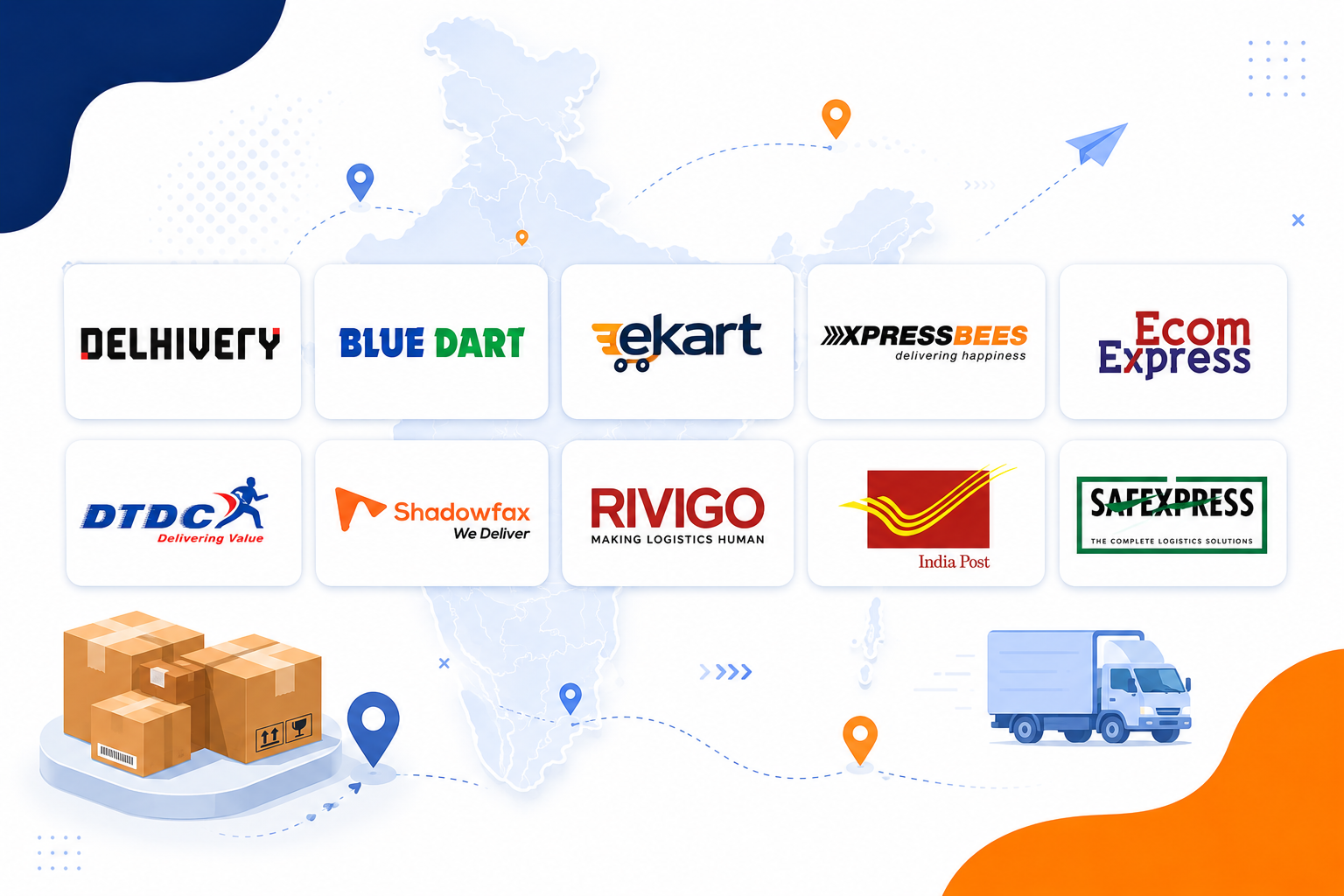
Top 10 Courier Companies in India 2026: A D2C Brand's Guide
Growth, CityMall | ShipPrime
The top courier companies in India each have a distinct network footprint, service mix, and ideal D2C use case. There is no single best carrier — there are 10 strong ones, and a well-run D2C brand uses 3–6 of them depending on where its orders ship.
Top 10 Courier Companies in India 2026: A D2C Brand's Guide
The top courier companies in India each have a distinct network footprint, service mix, and ideal D2C use case. There is no single best carrier — there are 10 strong ones, and a well-run D2C brand uses 3–6 of them depending on where its orders ship. This guide is a neutral overview of the 10 most relevant couriers for Indian D2C in 2026, with notes on where each fits and what to look for when building your carrier mix.
How should D2C brands evaluate courier companies?
Five evaluation axes that matter more than any single carrier comparison:
- Pincode coverage — depth in your target zones (metros, ROI, Special).
- Service mix — surface, express, air, reverse pickups.
- Last-mile quality — first-attempt delivery rate, NDR rate, RTO rate.
- Tech and integration — API quality, dashboard, tracking webhook reliability.
- Cost competitiveness — both per-shipment rate and total cost including reverse + RTO.
The 10 carriers below are listed in no particular order of "best to worst." Each wins on different axes.
1. Delhivery
One of India's largest integrated logistics players, with a deep distribution network covering metros, ROI, and most Special zones. Known for tech-forward operations and a strong D2C-focused API. Solid surface express performance; reverse pickup network is reliable across most categories.
- Strengths: pincode breadth, tech, reverse logistics scale, mid-mile reliability.
- Watch-outs: like every large carrier, last-mile performance can vary by region.
- D2C fit: a sensible default carrier for most D2C brands; particularly strong for ROI and Special zone shipments.
2. Blue Dart
India's premium express network, with strong air operations through its Domestic Priority service. Class-leading SLA on metro-to-metro lanes, particularly for time-sensitive shipments. Surface network exists but most D2C brands use Blue Dart specifically for premium air.
- Strengths: SLA reliability on metro corridors, brand trust, premium air network.
- Watch-outs: premium pricing means the math works only on the right shipments.
- D2C fit: high-AOV, time-sensitive, metro-heavy SKUs. Not a default for cost-sensitive surface volume.
3. XpressBees
A volume-D2C-focused carrier with one of the strongest reverse-pickup networks in the country. Competitive on Zonal and ROI surface lanes, with reverse pricing structured for high-return categories like apparel and footwear.
- Strengths: reverse logistics, surface express on Zonal/ROI, mid-volume D2C focus.
- Watch-outs: tier-3/4 ROI coverage varies; confirm pin serviceability for deeper destinations.
- D2C fit: apparel, footwear, accessories brands with significant return volume.
4. DTDC
One of the oldest distribution networks in India with deep tier-2/3 and Special zone reach. Layered service tiers (Surface, Plus, Premium) let brands pick speed-vs-cost per shipment.
- Strengths: deep ROI and Special zone coverage, reliable on long-tail destinations.
- Watch-outs: tech and dashboard are less D2C-native than newer carriers; integration may need extra setup.
- D2C fit: brands shipping heavily to Tier-2/3 cities, Northeast, J&K, and other under-served pincodes.
5. Ekart Logistics
Originally the in-house logistics arm of Flipkart, now a third-party logistics offering for D2C brands. Strong metro network density driven by Flipkart fulfillment volume; surface express performance is competitive on metro-to-metro lanes.
- Strengths: metro and Local zone coverage, native Flipkart marketplace integration.
- Watch-outs: reverse-pickup network depth is more limited than XpressBees or Delhivery in some categories.
- D2C fit: brands selling on Flipkart Marketplace or shipping heavily to metros.
6. Shadowfax
A pan-India logistics player with strong surface express and a notable intra-city network. Used widely for D2C across categories; emphasizes data-driven last-mile optimization.
- Strengths: surface express across metros and Zonal, intra-city options.
- Watch-outs: ROI tier-3 reach varies; confirm pin-level serviceability.
- D2C fit: metro-heavy brands needing a reliable surface partner with intra-city flexibility.
7. Ecom Express
A dedicated e-commerce logistics specialist with strong coverage in ROI and Tier-2/3 destinations. Built specifically for e-com volumes, with COD handling and reverse pickups as core offerings.
- Strengths: dedicated e-com network, ROI depth, COD handling.
- Watch-outs: best-fit volume bands change with their growth; confirm current contract terms.
- D2C fit: e-commerce brands with significant ROI volume and COD share.
8. India Post (Speed Post and BPCL)
India's largest pincode coverage by far — over 150,000 post offices across the country. Speed Post is used for documents and parcels; Business Parcel (BPCL) for e-commerce. Often the only carrier reaching the deepest Tier-4 and remote destinations.
- Strengths: unmatched pincode reach including rural, government-backed, lowest rates for some segments.
- Watch-outs: SLA is slower than private carriers, tech integration is basic, tracking is less real-time.
- D2C fit: backup carrier for the deepest pincodes where no private carrier serves reliably.
9. Amazon Shipping
Amazon's third-party logistics offering, available outside the Amazon marketplace. Strong metro and Tier-1 SLA driven by Amazon's own delivery network. Currently in expanding availability for D2C brands.
- Strengths: high SLA on metro lanes, leveraged Amazon delivery infrastructure.
- Watch-outs: limited geographic availability outside Amazon's core lanes; service terms evolve.
- D2C fit: brands selling on Amazon Marketplace or shipping metro-heavy that want an additional metro-strong carrier.
10. Shree Maruti / Trackon / Professional Couriers
The "regional and traditional" tier — long-established Indian couriers with strong region-specific networks. Often competitive on specific lanes (e.g. Gujarat-Maharashtra for Shree Maruti, certain Southern lanes for Professional) where the regional density beats national players.
- Strengths: lane-specific cost or speed advantages.
- Watch-outs: tech is typically less D2C-friendly; limited national scale.
- D2C fit: brands with concentrated geographic demand who want a regional cost optimizer.
How do you build the right carrier mix?
Most well-run D2C brands in India use 3–6 carriers concurrently rather than 1–2. The reasoning is straightforward:
- No single carrier wins every lane. Delhivery is strong on Delhi-NCR ROI; XpressBees is stronger on Maharashtra Zonal; DTDC owns Northeast.
- Single-carrier risk is real. A festive-season SLA breakage on your one carrier breaks your whole quarter.
- Mix-by-category optimization. Apparel returns route through reverse-strong carriers; high-AOV through premium SLA carriers; long-tail ROI through deep-network carriers.
Building this manually is operationally heavy. Aggregator platforms automate the allocation logic — you bring the order, the platform routes to the right carrier per lane and category.
For zone-wise rate comparison across these 10 carriers (and others) in one query, the shipping rate calculator lays out all 15+ options without manually pulling each rate card.
What should you actually look for in a courier partner?
Six diligence items before signing a direct contract or selecting a carrier on an aggregator:
- Pincode serviceability for your top 100 customer pincodes. If 12% of your demand isn't serviced, you're losing those orders.
- First-attempt delivery rate by zone. Ask for benchmarks; verify against your own data after 30 days of volume.
- NDR rate and resolution workflow. Some carriers' default NDR workflow is poor; you'll need aggregator-side or your own NDR automation.
- COD remittance cycle. D+2 vs D+7 vs D+15 changes your working capital substantially.
- Reverse-pickup pricing structure. Especially important for high-return categories.
- Dispute and claim process. How fast does the carrier resolve weight-correction, damage, and lost-shipment claims?
How does ShipPrime work across these carriers?
ShipPrime's panel includes 15+ courier partners, including most of the 10 above. The dashboard allocates each order to the carrier with the strongest network on that specific delivery pincode, factoring in cost, SLA history, and category-specific preferences (e.g. reverse-strong carriers for apparel returns).
NDR management workflow runs uniformly across all carriers — automatic re-attempt logic, customer comms, COD verification — so ops teams don't have to maintain 6 different processes. COD remits on a D+2 cycle regardless of which carrier handled the shipment.
Frequently Asked Questions
Which is the best courier company in India? There is no single best — each carrier wins on different axes. Delhivery, Blue Dart, XpressBees, DTDC, Ekart, Shadowfax, Ecom Express, India Post, Amazon Shipping, and regional couriers each have specific strengths. Most D2C brands use 3–6 of them concurrently.
Which courier is cheapest in India? Lowest list rates aren't always the lowest total cost — RTO charges, reverse pickup, and COD handling compound. Comparison by zone and category, not by per-shipment rate, gives the real answer. Aggregator platforms surface this comparison in one query.
Which courier is fastest in India? For premium metro corridors, Blue Dart's Domestic Priority typically leads. For surface express, Delhivery and Ekart are competitive. For deep ROI, DTDC's network often delivers faster than national average. The right answer depends on the specific lane.
Which courier has the best COD remittance? Direct contract cycles typically range D+7 to D+15. Through aggregators, cycles can shorten to D+2 across multiple carriers — usually faster than what individual brands negotiate directly at sub-10K-orders/day volume.
How many courier partners should a D2C brand use? Most well-run D2C brands use 3–6 carriers concurrently. Single-carrier brands face SLA-breakage risk; brands using more than 6 face operational complexity. The sweet spot depends on order volume and geographic spread.
Should I sign direct contracts or use an aggregator? At sub-10,000 orders/day, aggregators usually offer better rates than direct contracts because they pool D2C volume across thousands of sellers. Above that volume, hybrid is common — direct contracts for forward bulk + aggregator for reverse or specific carriers.
Closing Thought
The top 10 courier companies in India aren't ranked; they're complementary. A growing D2C brand's job isn't to pick "the best" carrier — it's to allocate the right shipment to the right carrier on the right lane. Multi-carrier strategy plus a strong NDR workflow is how the better-run D2C ops teams hit single-digit RTO and reliable customer SLAs.
Want to allocate across 15+ couriers from one dashboard? Start a free ShipPrime account or see ShipPrime pricing.
Ready to reduce your shipping costs?
Join thousands of D2C brands shipping smarter with ShipPrime — rates from ₹19/500g, D+2 COD remittance, and 15+ courier partners across India.
Get Started FreeHarsh Agarwal leads Growth at CityMall and ShipPrime. Previously, he was Senior Product Growth Manager at Airtel XLabs and worked on growth at Swiggy. He writes about shipping operations, unit economics, and what it takes to scale D2C brands in India.