
What is a Supply Chain Network? Design and Optimization for D2C Sellers
Growth, CityMall | ShipPrime
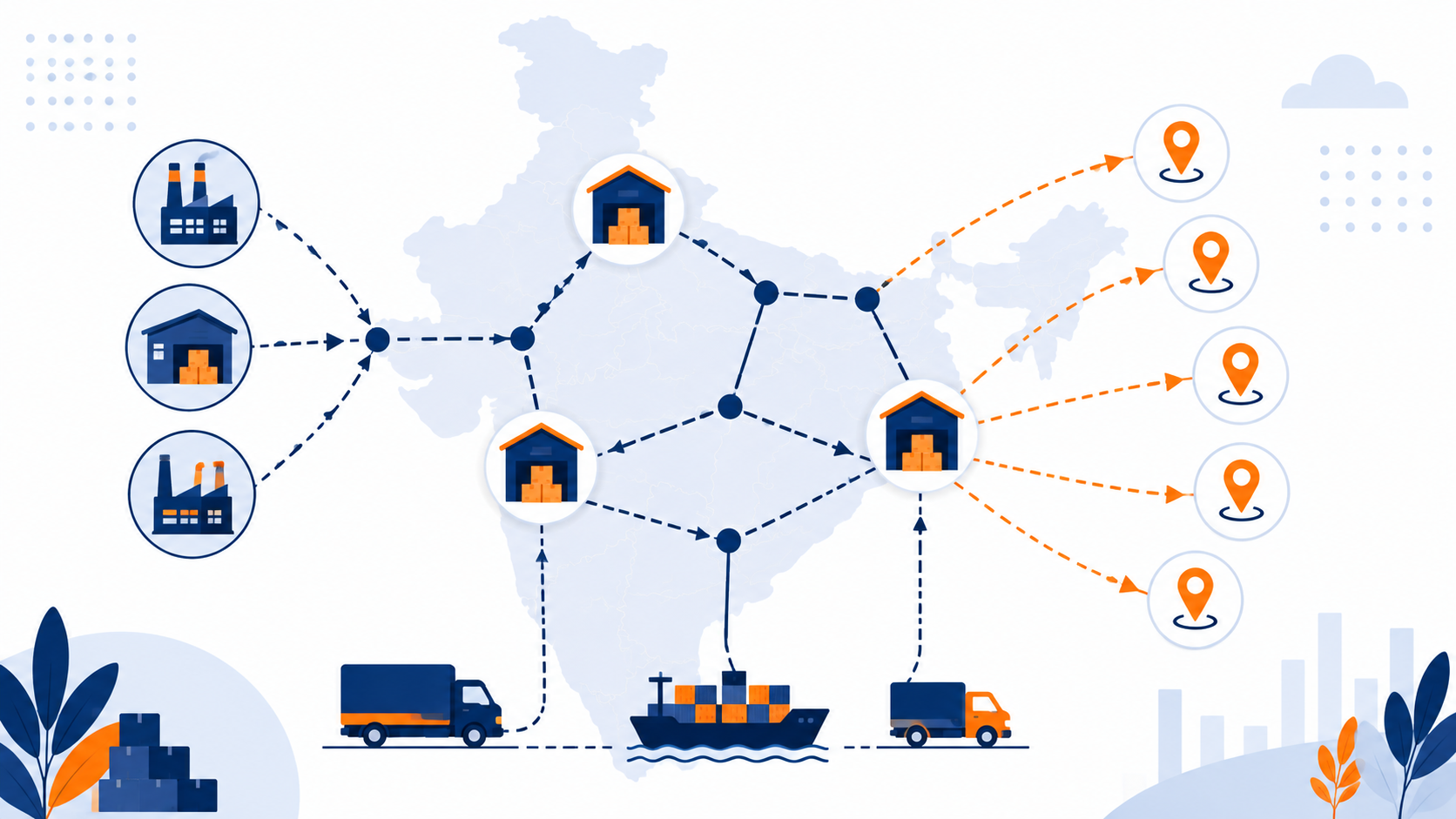
A supply chain network is the set of suppliers, warehouses, transport lanes, and customer-facing nodes that move your inventory from origin to delivery. For Indian D2C brands, network design decides whether you can promise 2-day delivery to a Patna customer — or quote 8 days and hope.
What is a Supply Chain Network? Design and Optimization for D2C Sellers
A supply chain network is the set of nodes — suppliers, warehouses, transport lanes, customer endpoints — that move your inventory from origin to final delivery. For Indian D2C brands, network design is the underlying decision that determines whether you can credibly promise 2-day delivery to a Patna customer, or whether you quote 8 days and hope.
Most D2C founders treat their supply chain network as fixed — one warehouse, one set of couriers, "good enough" for now. But the network is the highest-leverage decision in shipping economics. Adding a second warehouse, switching to a multi-courier mix, or consolidating long-haul lanes can shift cost-to-serve by 20–40% in a quarter. This post defines the components, the design rules, and the trigger points for redesign.
What does a supply chain network include?
Five node types and the lanes that connect them:
- Suppliers — raw materials, finished goods, packaging vendors
- Inbound transport — bulk freight from suppliers to warehouses
- Warehouses — single central, regional hubs, or fulfilment-partner sites
- Outbound transport — line haul + last-mile across 15+ courier partners and 18,700+ pincodes
- Customer endpoints — pincode-level delivery addresses across India
The complexity isn't in any single node — it's in the lanes between them. A 200-order/day brand might have 10 suppliers, 1 warehouse, 5 courier partners, and 2,000 active customer pincodes. That's a few hundred meaningful lanes to manage.
Why does network design matter for D2C?
Network design controls three things customers actually feel:
- Delivery time — distance from warehouse to customer plus carrier transit
- Shipping cost — distance, weight, zone, COD fee — all set by where inventory sits
- Stockout risk — single-warehouse setups stock-out on regional spikes; multi-warehouse setups don't
For a D2C brand at 500 orders/day shipping from a single Bengaluru warehouse, the median customer in Lucknow gets a 5-day delivery and a ₹220 effective per-order cost. Adding a small fulfilment node in Delhi cuts North India delivery to 2 days and effective cost to ₹160. Same brand, same products — different network.
What are the main network design models?
Model 1 — Single centralised warehouse
One warehouse serves all of India. Common starting setup.
- Pros: low capex, simple inventory management, one team to train
- Cons: long-haul shipping cost on 30–50% of orders, slow delivery to distant zones
Best for: brands under 200 orders/day, low SKU count, where customer geography is concentrated near the warehouse.
Model 2 — Regional hubs (2–3 warehouses)
Two or three warehouses placed to cover major demand clusters — typically one each in West (Bengaluru/Mumbai), North (Delhi NCR), and East (Kolkata) for pan-India brands.
- Pros: cuts average delivery time by 1–3 days, cuts shipping cost by 15–25%, lowers stockout risk
- Cons: higher inventory carrying cost (each SKU stocked at multiple sites), operational complexity, multi-warehouse WMS needed
Best for: brands at 500+ orders/day with national customer base.
Model 3 — Distributed fulfilment via 3PL network
Inventory placed at multiple 3PL partner warehouses across the country, often with software-managed allocation by pincode.
- Pros: near-customer delivery (1–2 days), variable-cost ops, scales without warehouse capex
- Cons: 3PL margin reduces unit economics, less control over packaging quality, integration overhead
Best for: brands at 1,000+ orders/day or with high seasonality.
Model 4 — Hybrid (own warehouse + 3PL nodes)
Central warehouse owned + 3PL nodes for specific regions where you don't have scale to justify your own.
- Pros: control where it matters, flexibility where it doesn't
- Cons: most complex to manage; needs strong tech stack
Best for: brands transitioning from Model 1 to Model 3 over 12–24 months.
When should a D2C brand consider redesigning its network?
Five trigger points:
- Average delivery time exceeds 4 days — your network is too centralised for your customer geography.
- Effective shipping cost per order exceeds 12% of AOV — too much long-haul, not enough regional inventory placement.
- Stockouts are concentrated in specific regions — single-warehouse demand spikes outpace inventory replenishment.
- RTO rate is highest in distant zones — long transit time amplifies "customer changed mind" and refusal rates.
- Order volume has 3×'d in 12 months — your old single-node setup is past its sweet spot.
Any one of these on its own justifies a network review. Two or more together is the trigger to act.
How do you actually optimize a supply chain network?
Step 1 — Map current demand by pincode
Pull 90 days of order data, plot by 6-digit pincode, identify the 20% of pincodes that drive 80% of orders. This is your demand map.
Step 2 — Compute current cost-to-serve by zone
For each zone (LOCAL, ZONAL, METRO, ROI, SPECIAL), calculate average shipping cost and average delivery time. Identify the worst-performing zones.
Step 3 — Model alternative network configurations
Run "what if we added a Delhi node" or "what if we used a 3PL in Hyderabad" against the demand map. Estimate the delivery-time and cost-per-order impact. The math is simple enough to do in Excel for most brands.
Step 4 — Pick the highest-ROI change
Don't redesign the whole network at once. Pick the single change with the best expected payback (usually a regional node in your worst-performing zone) and pilot it for 90 days.
Step 5 — Wire the routing logic
Once a new node exists, the question is which orders ship from where. This is the routing layer — typically handled by a WMS + shipping aggregator combination that knows your inventory placement and chooses the closest fulfilment point per order.
How does ShipPrime fit into supply chain network optimization?
ShipPrime sits at the outbound transport layer of your network. The platform routes orders across 15+ courier partners and 18,700+ pincodes by pincode-level SLA, surfaces transit-time and cost data by zone, and supports multi-warehouse setups where each warehouse has its own service area.
For brands evaluating a multi-warehouse move, the dashboard's zone-level cost-to-serve reporting is the data you need to model the case. For brands already operating multi-warehouse setups, ShipPrime's API supports warehouse-to-order routing rules so each parcel automatically ships from the closest fulfilment node. COD remittance lands in D+2 across all nodes, and transparent per-shipment pricing starts at ₹19/500g.
Frequently Asked Questions
What is a supply chain network in simple terms? A supply chain network is the set of suppliers, warehouses, transport lanes, and customer endpoints that move inventory from origin to final delivery. For D2C brands, the design of this network determines delivery speed, shipping cost, and stockout risk.
When should a D2C brand add a second warehouse? Common triggers: average delivery time over 4 days, effective shipping cost over 12% of AOV, recurring stockouts in specific regions, or 3× order growth in 12 months. Any one of these justifies a network review.
What are the main supply chain network design models? Four common models: single centralised warehouse, 2–3 regional hubs, distributed fulfilment via 3PL network, and hybrid (own + 3PL). Choice depends on order volume, SKU count, and customer geography.
How do you optimize a supply chain network for D2C? Map demand by pincode, compute zone-level cost-to-serve, model alternative configurations, pilot the highest-ROI change for 90 days, and wire warehouse-to-order routing logic via a WMS plus shipping aggregator.
Is a 3PL the same as a warehouse? No. A warehouse is a physical site that holds inventory. A 3PL (third-party logistics provider) is a service that operates one or more warehouses on your behalf and may also provide fulfilment and shipping. You can own a warehouse, lease a warehouse, or use a 3PL's warehouse.
Can a small D2C brand benefit from multi-warehouse setup? Below 200 orders/day, the inventory carrying cost of stocking SKUs across multiple sites usually outweighs the shipping savings. Above 500 orders/day with national customer base, multi-warehouse typically pays back inside 6 months.
Closing Thought
The supply chain network is the silent multiplier on every D2C decision. Customer acquisition pours orders into the network; the network decides whether those orders convert into repeat customers or one-time disappointments. Once you can model cost-to-serve and delivery time by zone, network design moves from being an instinct to being a quarterly business review item — which is where it belongs.
Want per-zone cost-to-serve data across 15+ couriers? Start a free ShipPrime account or see ShipPrime pricing.
Ready to reduce your shipping costs?
Join thousands of D2C brands shipping smarter with ShipPrime — rates from ₹19/500g, D+2 COD remittance, and 15+ courier partners across India.
Get Started FreeHarsh Agarwal leads Growth at CityMall and ShipPrime. Previously, he was Senior Product Growth Manager at Airtel XLabs and worked on growth at Swiggy. He writes about shipping operations, unit economics, and what it takes to scale D2C brands in India.