
Festive Season Shipping Playbook for D2C: Diwali, EOSS, BFCM 2026
Growth, CityMall | ShipPrime
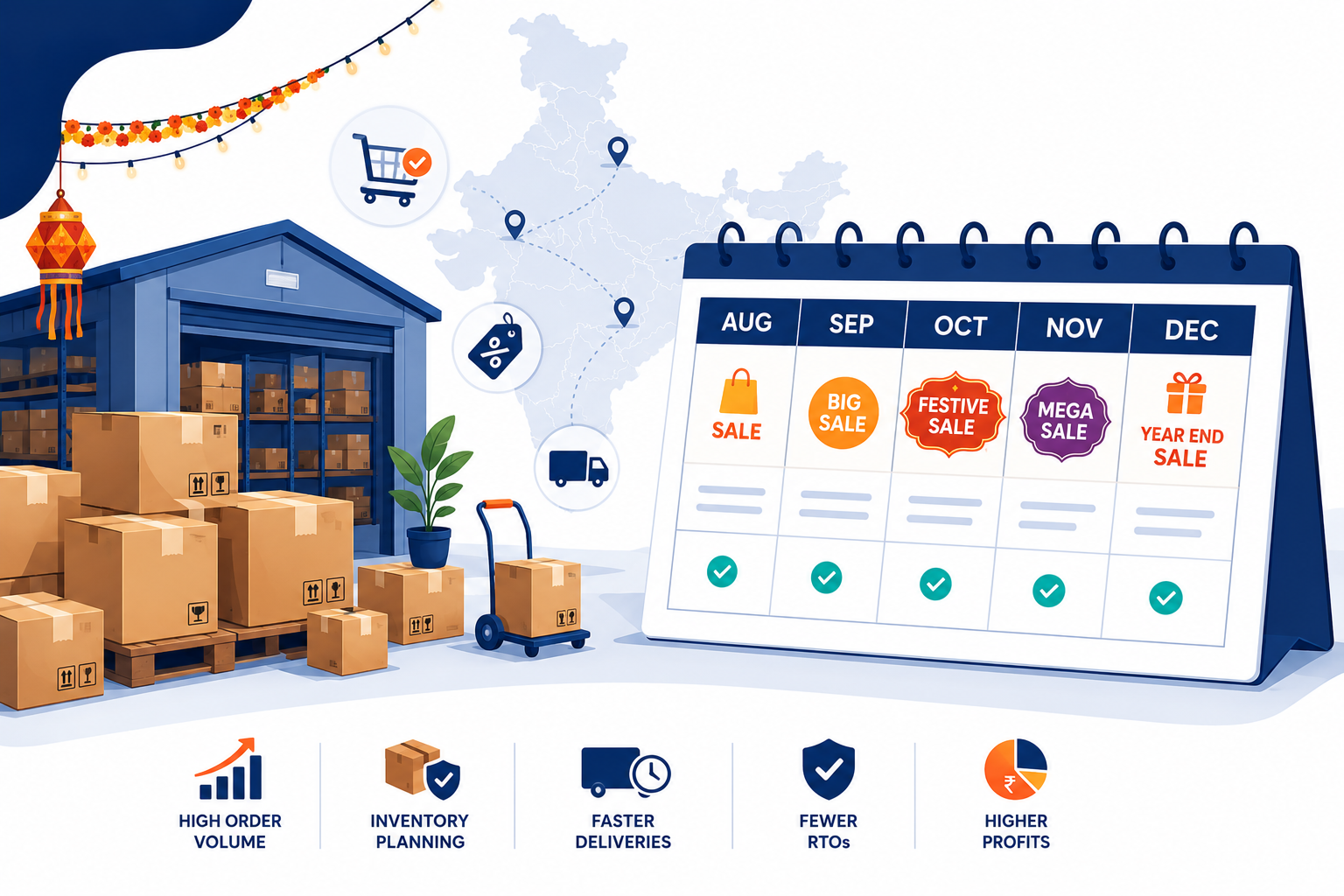
Festive season shipping in India runs August through December — a 5-month window where order volumes can spike 3–5x daily baseline, NDR rates rise sharply, and a single carrier missing SLA can break your whole quarter.
Festive Season Shipping Playbook for D2C: Diwali, EOSS, BFCM 2026
Festive season shipping in India runs August through December — a 5-month window where order volumes can spike 3–5x daily baseline, NDR rates rise sharply, and a single carrier missing SLA can break your whole quarter. Brands that plan in distinct phases hit the season with delivery rates intact; brands that improvise lose 8–12% of festive revenue to RTO and customer-experience damage.
This playbook covers the four-phase plan that the better-run D2C ops teams in India use, with practical checklists for each phase.
What does India's festive sale calendar look like in 2026?
Five concentrated peaks across August to December. Each has a slightly different shipping profile.
| Window | Approximate dates | Volume profile | Key risk |
|---|---|---|---|
| Independence Day sales | Aug 10–20 | 1.5–2× baseline | First-stress test of post-monsoon supply chain |
| End-of-Season Sale (EOSS) | Sept 1–30 | 2–3× baseline | Apparel-heavy; high return-rate exposure |
| Diwali sale cluster | Oct 1 to Diwali (Oct/Nov) | 3–5× baseline | The biggest forward-volume peak |
| BFCM / Black Friday | Nov 24–30 | 2–3× baseline | Imported tailwind; growing year-on-year in India |
| Christmas / New Year | Dec 20–31 | 1.5–2× baseline | Final push; last-mile bandwidth tight |
Diwali is the dominant event. Most ops planning anchors around it; the others fit inside the same operational rhythm.
Why does shipping break during festive season in India?
Three structural reasons:
- Carrier capacity is finite and shared across all brands. Every D2C brand and marketplace is pushing through the same Delhivery, Blue Dart, XpressBees, DTDC, Ekart, and Shadowfax pipes. When demand 4× and capacity grows 1.3×, SLA breakage is mathematical.
- Last-mile bandwidth saturates first. Hub and line-haul scale; bike-and-foot delivery agents don't scale linearly. NDR rates rise because agents can't complete the same number of stops per shift.
- Customer expectations don't flex. Buyers placing Diwali gift orders expect them before the festival, not D+7. Late deliveries hit refunds and NPS regardless of carrier SLAs.
The brands that handle festive well don't have a magic carrier — they have a 4-phase plan that anticipates each of these.
Phase 1: Pre-season prep (T-45 days)
Six tasks, none of them last-minute:
- Lock carrier capacity. Talk to each carrier (directly or through your aggregator) and confirm forward-volume capacity, reverse-pickup bandwidth, and any festive-window cutoffs. Aggregators absorb capacity risk across multiple carriers — useful precisely when one breaks.
- Inventory placement. Forward-position SKUs to fulfillment centers nearest demand. A Delhi-NCR-heavy sale list shipped from a Bangalore warehouse adds 1–2 days to D+ across every order.
- Packaging stockpile. Order 60–90 days of poly mailers, cartons, fillers, and labels. Vendor lead times stretch during the same window your demand spikes.
- Address quality cleanup. Pre-festive is when you scrub pincode coverage on every carrier's serviceability sheet. Catch gaps before customers find them.
- COD risk model refresh. New-buyer COD rejection rates rise during festive. Refresh your risk model with the last 90 days of data.
- CX team scale-up. Hire or backfill CX seats early. Mid-Diwali is the worst possible week to onboard a new agent.
If you want to compare carrier capacity and rates across 15+ partners during planning, the shipping rate calculator is the fastest tool to model forward economics.
Phase 2: Pre-launch (T-15 days)
Five tasks. This is your run-book and staffing phase.
- Draft the festive run-book. A document that says: on-call rota, escalation paths, hourly SLA checks, daily standups, who decides what when.
- NDR ops staffing. Plan for 2–3× normal NDR volume in the peak week. The NDR management workflow should be tuned: auto re-attempt rules, customer-side reschedule capture, IVR routing.
- Dry-run COD verification. New-buyer COD orders should hit verification before manifest during festive. Test the workflow end-to-end before live volume.
- Customer-facing comms templates. SMS, WhatsApp, email — pre-written for every shipment status. Reduces inbound CX volume materially.
- Returns/RTO inbox staffing. Returns spike post-Diwali, not during. Have inbound capacity ready for the second half of November.
Phase 3: Live (during the peak)
Daily rhythm. Six checks every day:
- Hourly SLA monitor by carrier × zone. If Delhivery's metro SLA slips one day, allocation shifts the next morning.
- NDR triage twice daily. Re-attempt requests filed before end-of-day; customers with multiple failed attempts called personally.
- COD verification queue. Cleared at least twice daily.
- Inventory burn check. Stock-out risk on hero SKUs is the most common festive miss.
- Customer comms hygiene. Tracking page updates flowing; SMS/WhatsApp templates firing.
- Daily standup with ops + CX + supply. 15 minutes. Action items only.
The brands that don't run a daily standup during festive end up firefighting on Day 12 with no shared context. Don't skip it.
Phase 4: Post-mortem (T+15)
Five activities in the two weeks after the peak:
- RTO investigation by carrier × zone. Why did each carrier's RTO rate move? Was it carrier-side, customer-side, or process-side?
- Claim filing. Damaged-in-transit, lost, and weight-correction disputes have filing windows (typically 7–30 days). Don't miss them.
- Reverse-pickup throughput. Returns spike now; backlog clears or doesn't depending on carrier capacity. Track and escalate.
- Customer retention follow-up. Repeat-purchase windows are critical post-festive. CRM should fire personalized offers to new buyers.
- Postmortem document. What worked, what broke, what to change for the next sale window. The Phase 1 prep for next year starts from this document.
What does multi-carrier allocation buy you during festive?
A single-carrier brand whose chosen carrier hits a Day 4 SLA breakage has no fallback. A multi-carrier brand absorbs the same breakage by shifting allocation — Delhivery slips, XpressBees and DTDC pick up the slack on those lanes for 48 hours. The customer-facing SLA holds.
Aggregators are designed for exactly this — pooled capacity across carriers, dynamic allocation, single dashboard for tracking the mix. Brands running an aggregator going into festive treat it as their main capacity-risk hedge.
How does ShipPrime handle festive shipping?
ShipPrime's 15+ courier partner panel and dynamic allocation engine is built for the kind of variance festive brings. When one carrier's SLA on a specific lane breaks, orders for that lane shift to the next-strongest carrier automatically — without ops having to manually re-route.
The NDR management workflow handles 2–3× normal NDR volume with the same automation: re-attempt logic, customer comms, escalation triggers. COD remittance stays on the D+2 cycle even at festive volume — important when working capital tightens and inventory reorder timing matters.
For ops teams, the dashboard's hourly SLA monitor by carrier × zone is the single screen that drives the daily allocation review during peak.
Frequently Asked Questions
When does India's festive shipping season start in 2026? The peak window runs August through December, with Independence Day sales kicking off in mid-August, EOSS in September, Diwali in October/November, BFCM in late November, and Christmas/New Year in December. Diwali is the largest peak.
How much does shipping volume spike during festive season? Diwali peak typically runs 3–5× baseline daily volume. EOSS and BFCM run 2–3×. Independence Day and Christmas run 1.5–2×. Capacity planning anchors on the Diwali peak.
Why do RTO rates rise during festive sales? Carrier last-mile bandwidth saturates, NDR rates rise (failed first attempts), customer availability drops (festive travel), and new-buyer COD rejection rates increase. Multi-carrier allocation and tightened NDR workflows are the two biggest levers to keep RTO contained.
How early should D2C brands start festive shipping prep? T-45 days minimum for inventory placement, packaging stockpile, and carrier capacity confirmation. T-15 for run-book, CX staffing, and final dry-runs. Anything later usually catches the brand mid-peak.
Does multi-carrier shipping help during festive? Yes — significantly. A single-carrier brand has no fallback when its chosen carrier breaks SLA on a specific lane. Multi-carrier allocation lets orders shift to the next-strongest carrier on each lane automatically.
What's the most common festive shipping mistake? Skipping the daily standup. Brands that don't run a 15-minute daily cross-functional check (ops + CX + supply) end up making isolated decisions that compound; by Day 10 they're firefighting without shared context.
Closing Thought
Festive shipping isn't about heroics during the peak — it's about the boring discipline of Phase 1 prep and Phase 4 postmortems. Brands that treat the 45-day pre-peak as their most important sprint of the year hit December with their customer NPS, RTO rates, and carrier relationships intact.
Want to allocate festive volume across 15+ couriers from one dashboard? Start a free ShipPrime account or see ShipPrime pricing.
Ready to reduce your shipping costs?
Join thousands of D2C brands shipping smarter with ShipPrime — rates from ₹19/500g, D+2 COD remittance, and 15+ courier partners across India.
Get Started FreeHarsh Agarwal leads Growth at CityMall and ShipPrime. Previously, he was Senior Product Growth Manager at Airtel XLabs and worked on growth at Swiggy. He writes about shipping operations, unit economics, and what it takes to scale D2C brands in India.